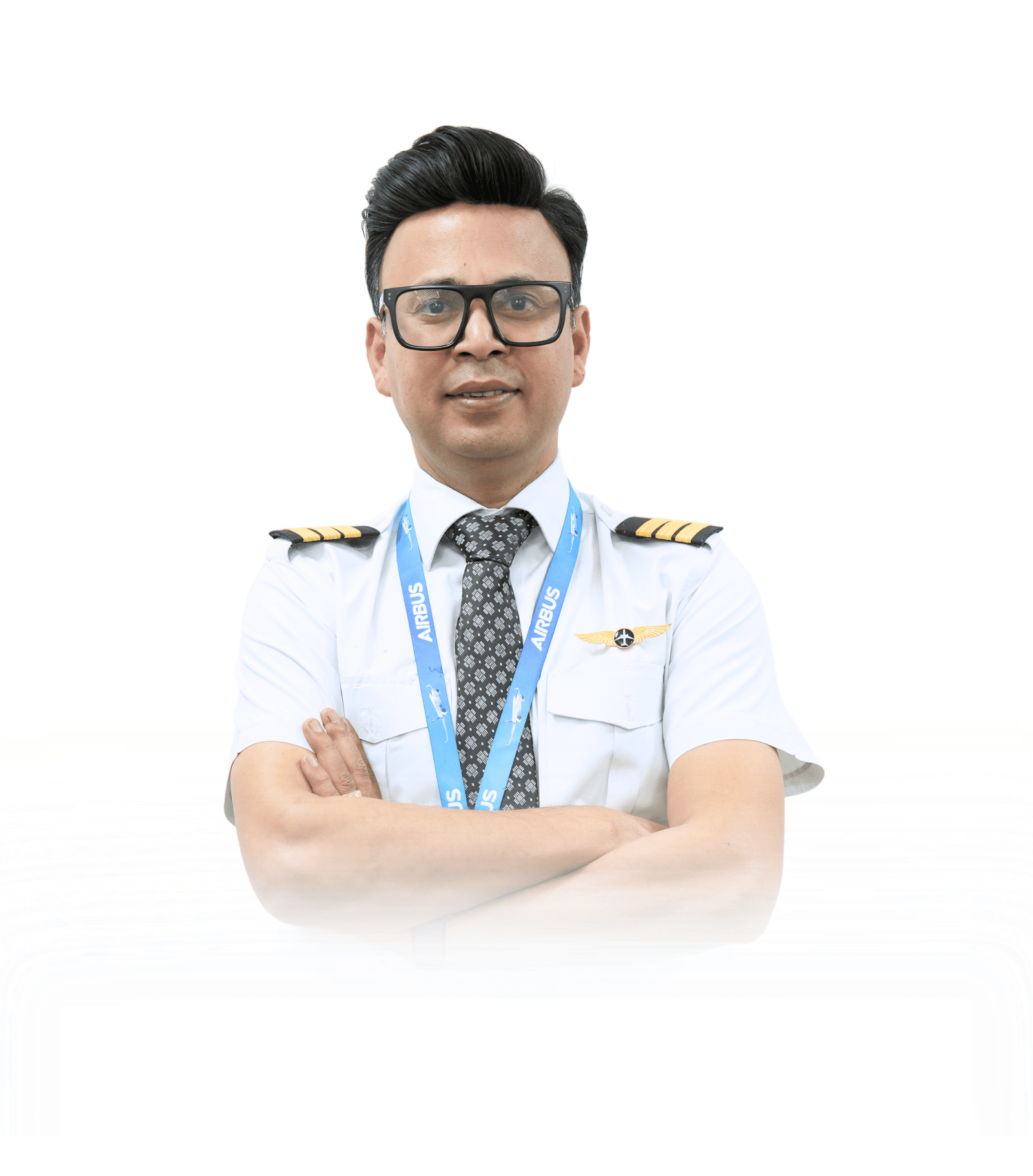
Capt. Tomar Awdhesh flew with IndiGo, co-founded Golden Epaulettes Aviation and wrote Mastering the Airline Pilot Interview. Over 18 years GEA has trained more than 4,000 pilots from its centre in Dwarka, New Delhi.
If you want to become a pilot in India, start by checking your eligibility, creating your eGCA profile and booking your initial Class 2 medical. My advice is to get these steps under way before committing money to flying training.
At a glance
| Requirement | Details |
|---|---|
| Minimum age | 18 on the date you apply for the CPL |
| Education | Class 12 pass with Physics and Mathematics |
| Medical | Initial Class 2 first, then Class 1 for the CPL |
| Budget | About ₹80–85 lakh self-sponsored including type rating, or ₹1–1.7 crore through an Indian airline cadet programme (planning estimates) |
| Time | About four years from ground school to a first airline stipend on the overseas cadet route |
Step 1. Check your eligibility for a Commercial Pilot Licence
- Age. You must be at least 18 on the date you apply for your Commercial Pilot Licence (CPL).
- Education. You must have passed Class 12 or an equivalent examination with Physics and Mathematics from a recognised board or university. The CPL rule requires a pass. Flying schools and airline cadet programmes may set their own admission cut-offs.
- Medical fitness. You need a Class 1 medical assessment for the CPL. Start by arranging your initial Class 2 medical.
Step 2. Create your eGCA profile
Keep your Class 10 marksheet, identity proof and address proof ready. Use an email address and mobile number you can access yourself.
Step-by-Step eGCA Registration
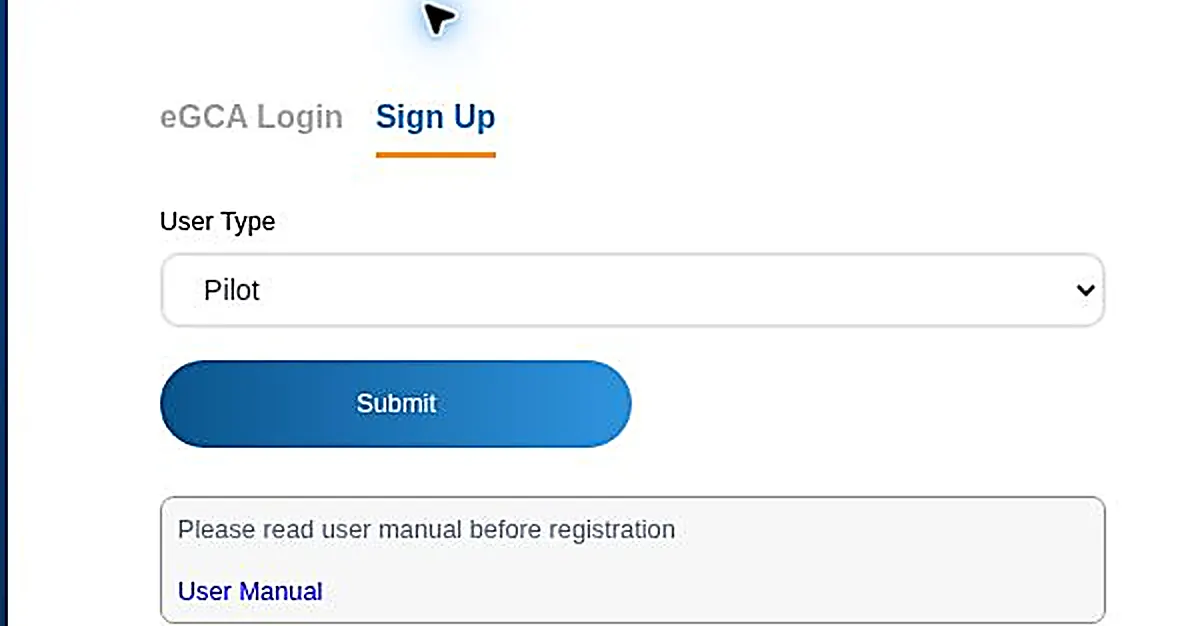
1. Click Sign Up and select Pilot
On the eGCA login page, click Sign Up. Under User Type, choose Pilot and click Submit.
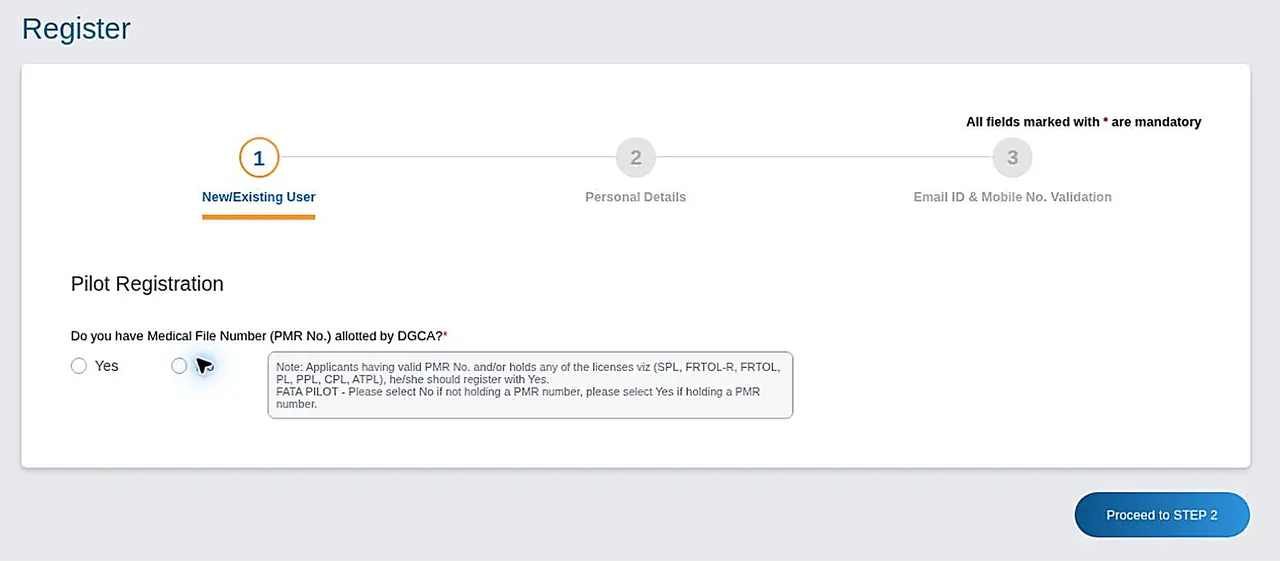
2. Answer the Medical File Number question
Select No if you have neither a DGCA Medical File Number (PMR No.) nor any of the licences listed on the screen. Otherwise select Yes and follow the portal instructions. Click Proceed to STEP 2.
3. Enter your personal details
Enter your name and date of birth exactly as they appear on your Class 10 marksheet. Use DD/MM/YYYY. Complete the required fields and your correspondence address, then click Proceed to STEP 3.
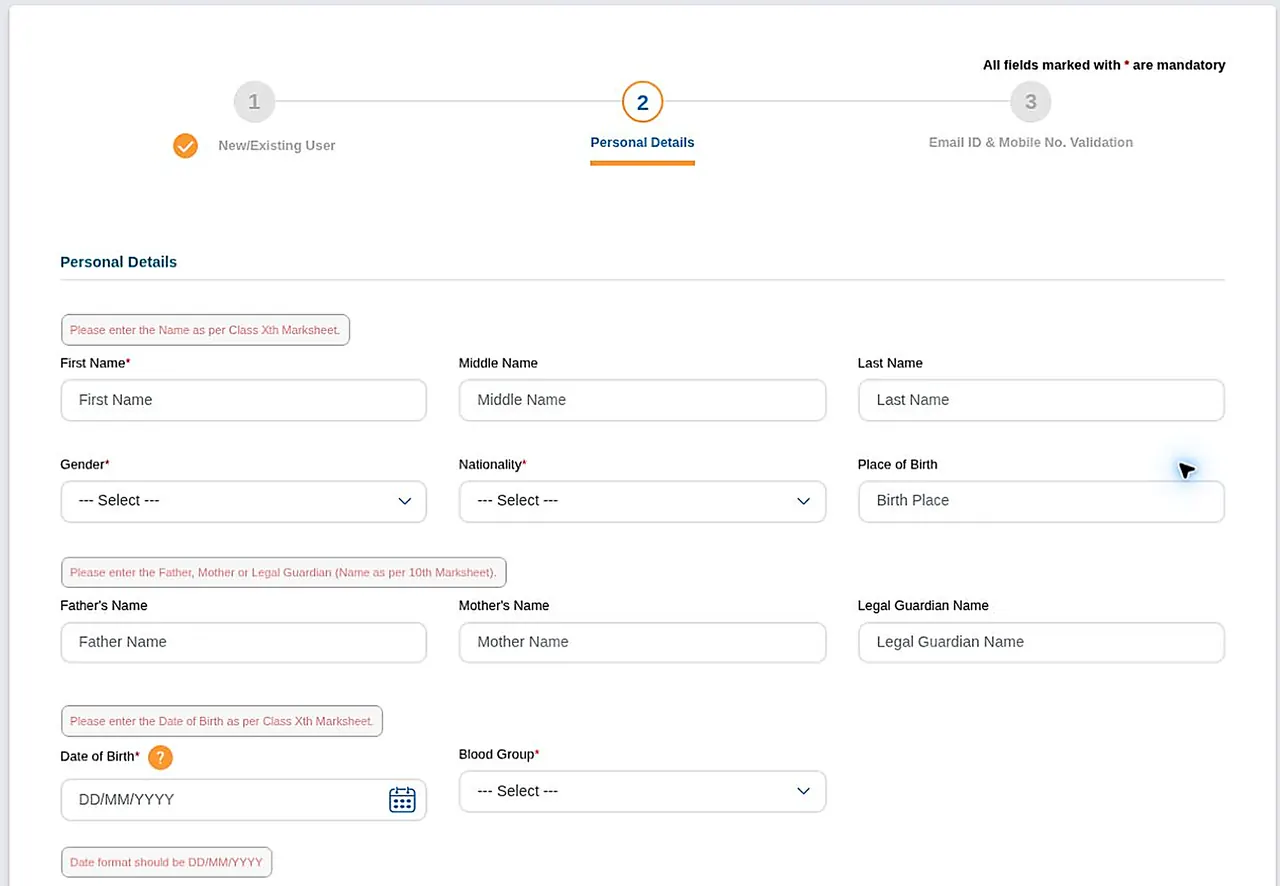
4. Upload, verify and submit
- Attach the requested documents. Select each proof type on the portal and upload the matching file. Follow the format and size limits shown. Upload a photograph or signature if requested, and follow the password rules shown on the screen.
- Verify your email and mobile number. Complete the login fields and CAPTCHA. Enter the OTPs in the matching verification fields.
- Review and submit. Check your name, date of birth, contact details and attachments. Complete the CAPTCHA again if prompted, click Submit, and save your eGCA ID.
5. Log in and find Medical Services
Sign in with your eGCA ID and password. Complete any CAPTCHA or OTP prompts, then open the Medical section for the service that applies to you.
Step 3. Book your initial DGCA Class 2 medical
Find a DGCA-empanelled Class 2 medical examiner in your city or the nearest available city. Check the examiner’s empanelment validity, then call the clinic and ask for an initial Class 2 medical for a first-time pilot applicant. Download the DGCA Class 2 medical examiner list.
When can you do the Class 2 medical?
You can plan your initial Class 2 medical before, during or after Class 12, depending on your schedule and eligibility. If you are still in school, especially if you are under 18, confirm the examiner’s age and documentation requirements before booking. Have your eGCA ID and an original government-issued photo ID ready. A passport is one example. If you plan to use Aadhaar, confirm that the clinic accepts it for this examination.
Before your appointment
Ask the clinic which documents to bring, whether you need to fast and which tests should be done in advance. Keep the photo ID you used for eGCA handy. If you wear spectacles, ask whether to bring a current prescription. Tell the examiner about any previous surgery, regular medication or existing medical condition, and ask which reports to bring.
What does the medical cover?
The assessment covers eyesight and colour perception, hearing, cardiovascular health, general fitness and medical history. The exact investigations depend on the class of medical, your age and the examiner’s findings. Get the checklist for your appointment before booking blood tests, scans or specialist consultations.
After your Class 2 medical
If the examiner issues you a fit Class 2 medical certificate (CA-35), keep a copy. DGCA allows you to use it to apply directly for your initial Class 1 medical. My advice is to complete your Class 1 before paying a substantial non-refundable flying-school or cadet programme fee.
Step 4. Verify your Class 10 and Class 12 board documents
This step prepares your school records for your DGCA Computer Number application on Pariksha. Check both classes individually, especially if you studied under different boards.
If your documents are available in DigiLocker
- Log in to DigiLocker and search for the issuing board for each class. Fetch the board-issued marksheet or certificate for your examination year.
- In the DGCA Pariksha Flight Crew registration, use the DigiLocker option and give consent to retrieve your issued documents. Check that Pariksha successfully fetches and verifies the records.
- Skip the separate Board Verification Certificate (BVC) for the documents successfully fetched through Pariksha. This applies to CBSE candidates and to candidates from other recognised boards whose records can be fetched and verified. If one class is verified through DigiLocker, follow the manual process for the other class.
Open the DGCA Pariksha DigiLocker registration page.
Manual scrutiny route
Follow the manual route if your board does not provide issued records through DigiLocker, automated verification fails because your details do not match, or your foreign or equivalent qualification requires manual review. Follow up with the board that issued your Class 10 and Class 12 or equivalent marksheets. If different boards issued them, contact each board separately.
Board Verification Certificate (BVC). Ask the issuing board or university to verify the authenticity of your marksheets for the DGCA Computer Number application. DGCA also accepts eligible online verification through the issuing board’s website when it can access the verification details supplied in your application.
How to submit the BVC
| Addressee or qualification | What to submit |
|---|---|
| CEO, DGCA or “To Whomsoever It May Concern” | The original BVC must reach the Central Examination Organisation by the date you submit your online application. Address it to CEO, DGCA, East Block III, Level III, R.K. Puram, New Delhi 110066. |
| Flying Training Organisation (FTO) | Upload a PDF copy attested by the Chief Flying Instructor (CFI). |
| Candidate | Upload a self-attested or attested PDF copy. |
| Foreign or international qualification | Ask the issuing board or university to send the verification from its official email address. The manual lists ceo.dgca@nic.in and help.pariksha.dgca@gov.in for foreign-university verification. Upload a self-attested Association of Indian Universities (AIU) equivalence certificate where applicable. |
Upload format. Use a clear PDF scan of the original BVC or the appropriately attested copy. The maximum BVC upload size is 100 KB. DGCA Pariksha Flight Crew User Manual, sections 2.5 and 2.5.4
Step 5. Check that your documents match
Before you apply for your DGCA Computer Number, lay out these documents and compare them side by side.
- Aadhaar card
- Passport, if already issued
- Class 10 marksheet and certificate
- Class 12 marksheet and certificate
Check your full name, date of birth, mother’s name and father’s name wherever those details appear. Names should match exactly, including spelling, initials and the order of names. Check that the date of birth is the same across all documents.
Even a small discrepancy can delay your Computer Number application or cause questions during airline joining checks. If you find a mismatch, contact the authority that issued the document and start the correction process early. Corrections can take time.
Step 6. Apply for your DGCA Computer Number
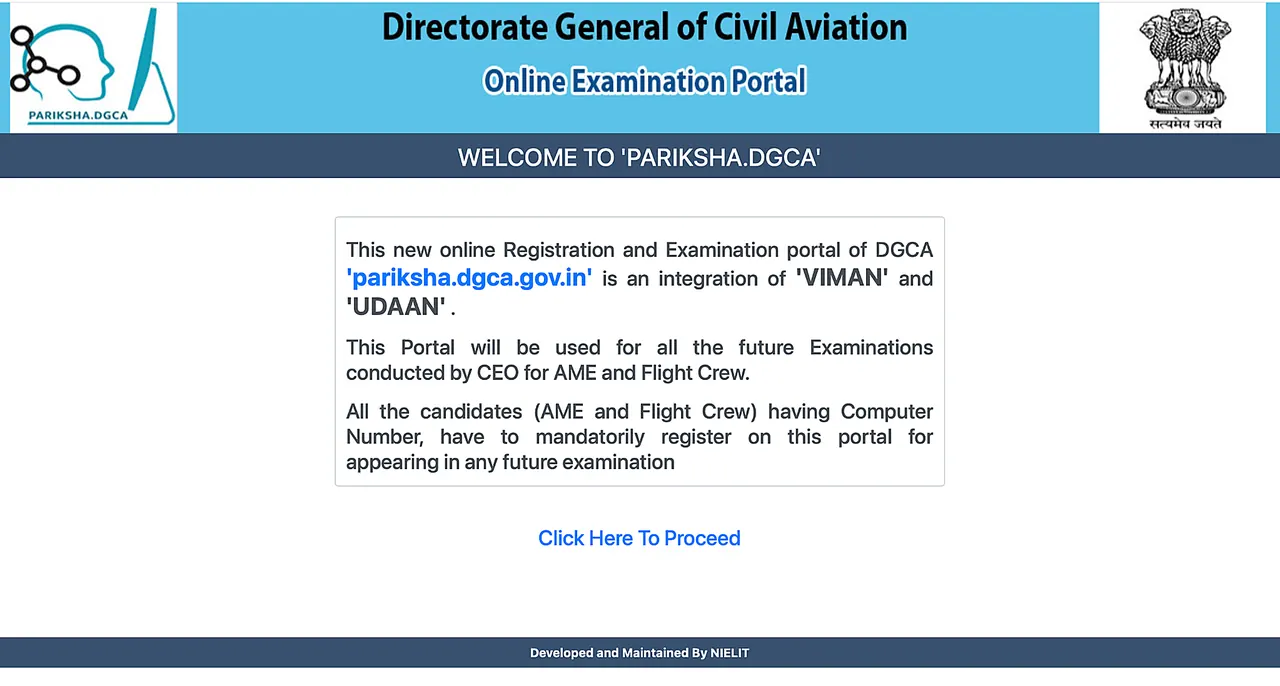
1. Open DGCA Pariksha
Go to the DGCA Pariksha portal and select Click Here To Proceed.
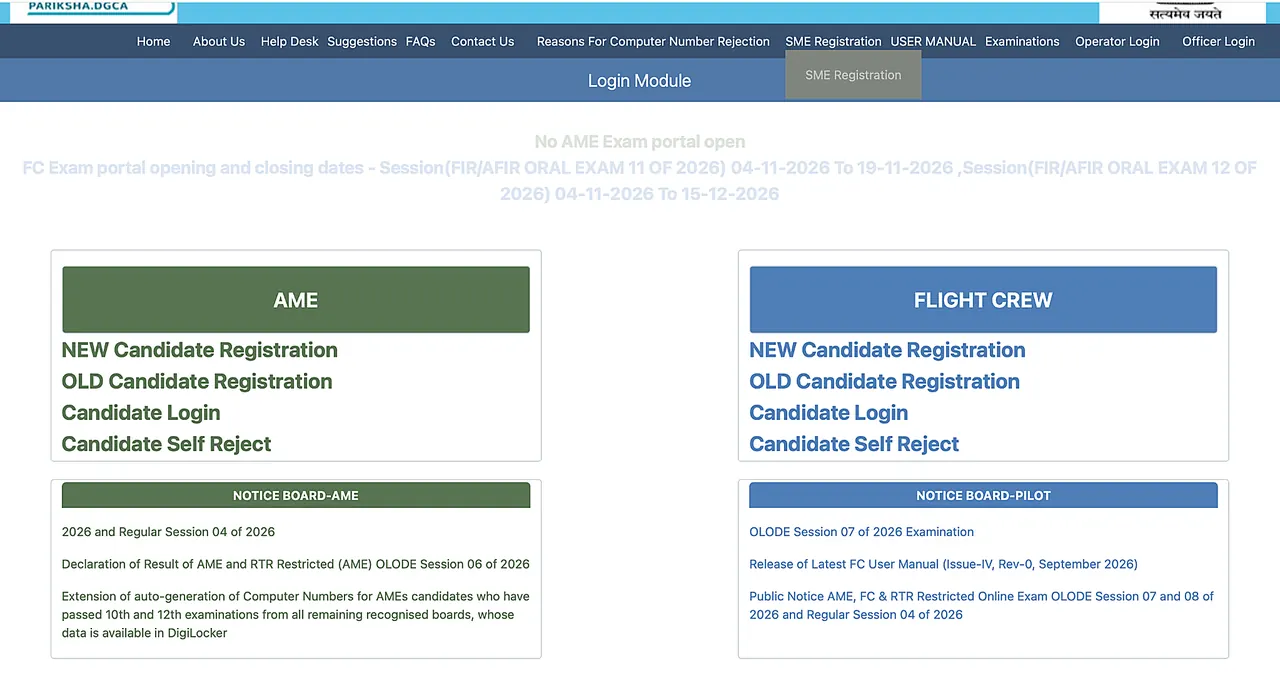
2. Select New Candidate Registration
Under Flight Crew, click NEW Candidate Registration.
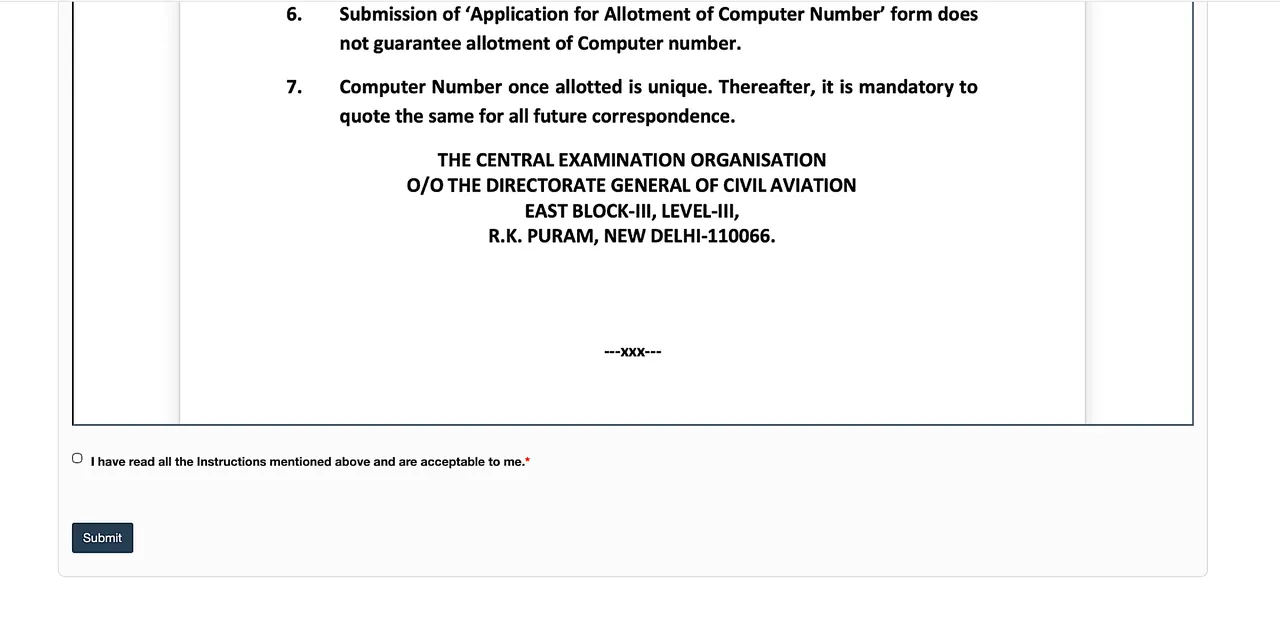
3. Read and accept the declaration
Read the instructions, tick the declaration checkbox and click Submit to continue to the route selection screen.
4. Choose your application route
Select YES to use DigiLocker for automatic Computer Number generation if you meet the criteria below. Select No for manual scrutiny and follow the board-verification guidance in Step 4.
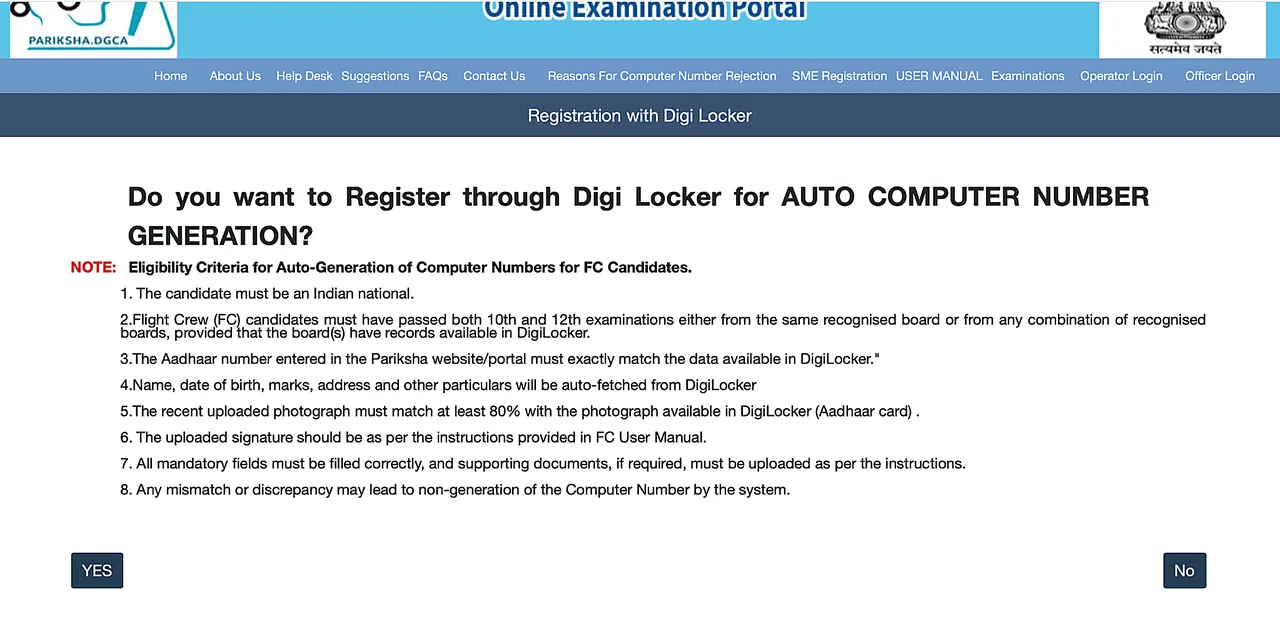
Who can use automatic Computer Number generation?
- You must be an Indian national.
- You must have passed Class 10 and Class 12 through recognised boards. The boards may be the same or different, provided both sets of records are available through DigiLocker.
- The Aadhaar number you enter in Pariksha must match the Aadhaar data in DigiLocker exactly.
- Pariksha retrieves your name, date of birth, marks, address and other particulars from DigiLocker. Check the retrieved details before you continue.
- DGCA’s portal requires your recent uploaded photograph to score at least an 80% match with your Aadhaar photograph in DigiLocker.
- Upload your signature as specified in the Flight Crew User Manual.
- Complete all mandatory fields and upload any supporting documents requested by the portal.
- A mismatch or discrepancy can prevent automatic generation. Check your details against Step 5 and use the manual scrutiny route if applicable.
Official DGCA Pariksha eligibility criteria
Automatic Computer Number generation through DigiLocker
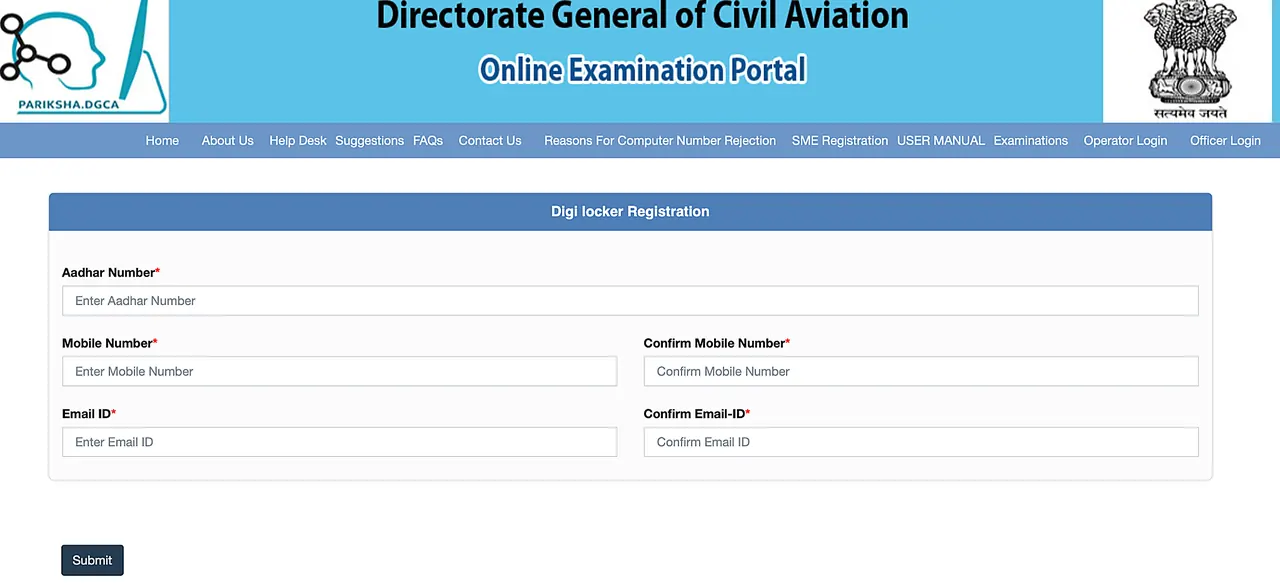
1. Select Yes and enter your basic details
If you meet the criteria above, select YES. Enter your Aadhaar number, mobile number and email address. Confirm your mobile number and email address, then click Submit. Keep the phone linked to your Aadhaar handy for the DigiLocker OTP.
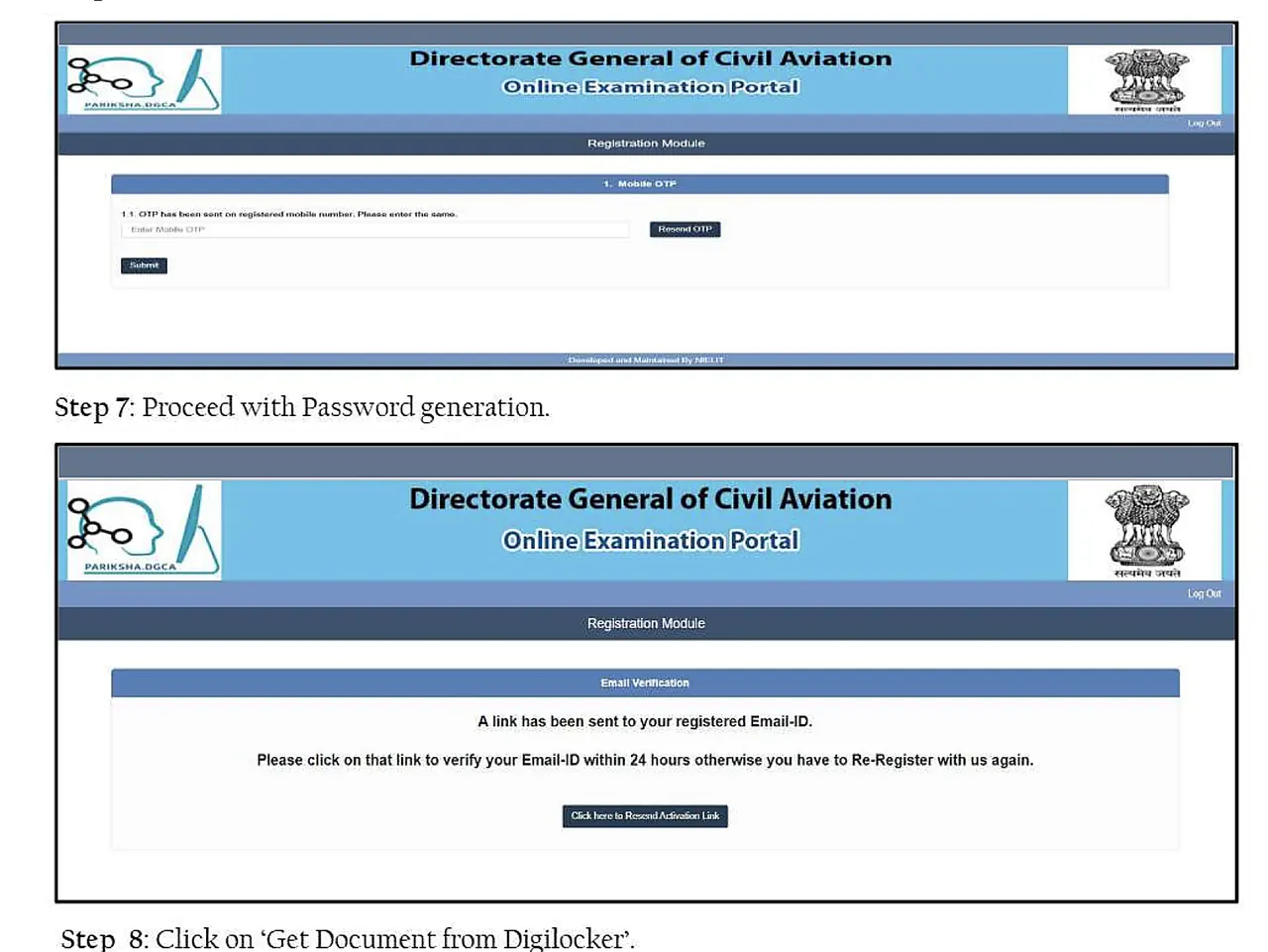
2. Verify your mobile number and email
Enter the OTP Pariksha sends to your registered mobile number. Open the verification link sent to your email and follow any prompts to set your Pariksha password.
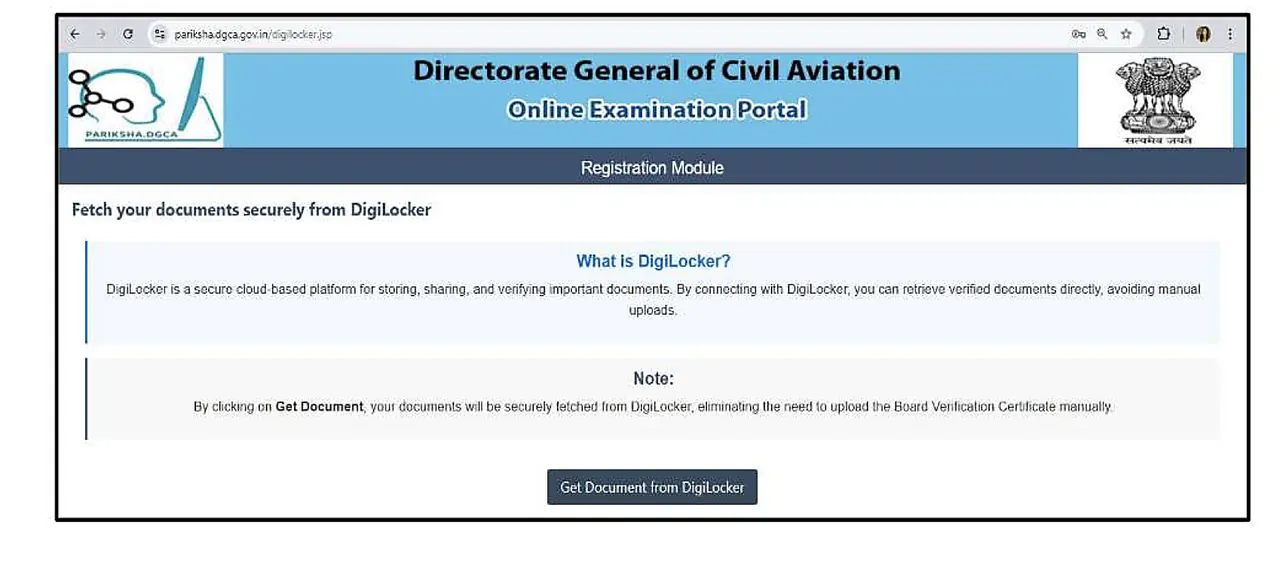
3. Fetch your documents and authorise DigiLocker access
Click Get Document from DigiLocker.
On the DGCA KYC screen, enter your Aadhaar number and complete the CAPTCHA. Click Next, then enter the OTP sent to the mobile number linked to your Aadhaar.
DGCA KYC Application
Confirm your identity
- Aadhaar number
- Enter your Aadhaar number
- CAPTCHA
- Enter the characters shown on the portal
Next
If DigiLocker asks for your six-digit security PIN, enter the PIN you set when creating your DigiLocker account. Follow the prompts to allow DGCA to access your documents.
DigiLocker security PIN
You are already registered with DigiLocker
- Six-digit security PIN
- Enter the PIN you set for DigiLocker
- Forgot security PIN?
- Use the recovery option if needed
Continue
4. Check the retrieved details, complete your address and proceed
Pariksha pre-fills personal details retrieved through DigiLocker, including your name, parents’ names and date of birth, using your Class 10 records. Compare these with your original documents. The pre-filled personal fields are locked. If they match, complete the remaining address fields and click Save and Next.
Pariksha registration
Personal details · Pre-filled and locked
- First name
- Ananya
- Middle name
- Meera
- Last name
- Verma
- Mother’s name
- Kavita Verma
- Father’s or guardian’s name
- Rajeev Verma
- Date of birth
- 14/06/2007
- Title
- Ms
- Gender
- Female
- Mobile number
- 98XXXXXX42
- Email ID
- ananya.verma@example.com
- Aadhaar number
- XXXX XXXX 1234
Address details
- Correspondence address
- Address lines, town or city, country, state or UT, and PIN code
- Permanent address
- Indicate whether it matches your correspondence address. Complete the separate fields if needed.
Save and Next
If the details differ from your documents, switch to the manual scrutiny route and follow the board-verification guidance in Step 4. See Step 5 for the details to check across your documents.
Continue your automatic Computer Number application
5. Complete the Flight Crew Details page
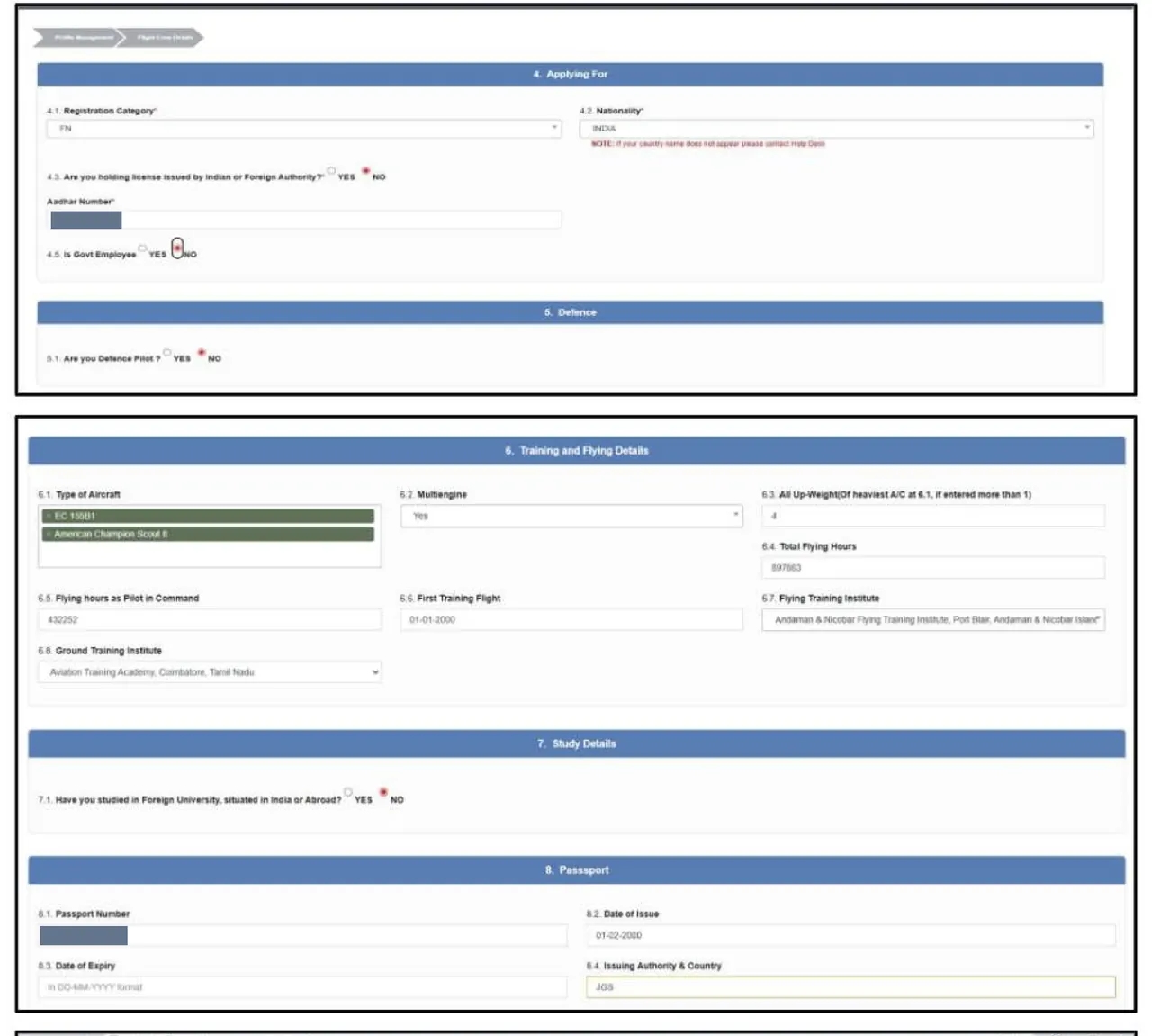
After clicking Save and Next, select CPL under Registration Category. Answer whether you hold a licence issued by an Indian or foreign authority, whether you are a government employee and whether you are a defence pilot. Select Yes or No according to your circumstances. Check the Aadhaar number already fetched by the portal.
If you have yet to start training or do not have a passport, leave the corresponding fields blank where the portal allows it. Answer the foreign-study question as applicable, then continue to Education.
6. Review your pre-filled education details
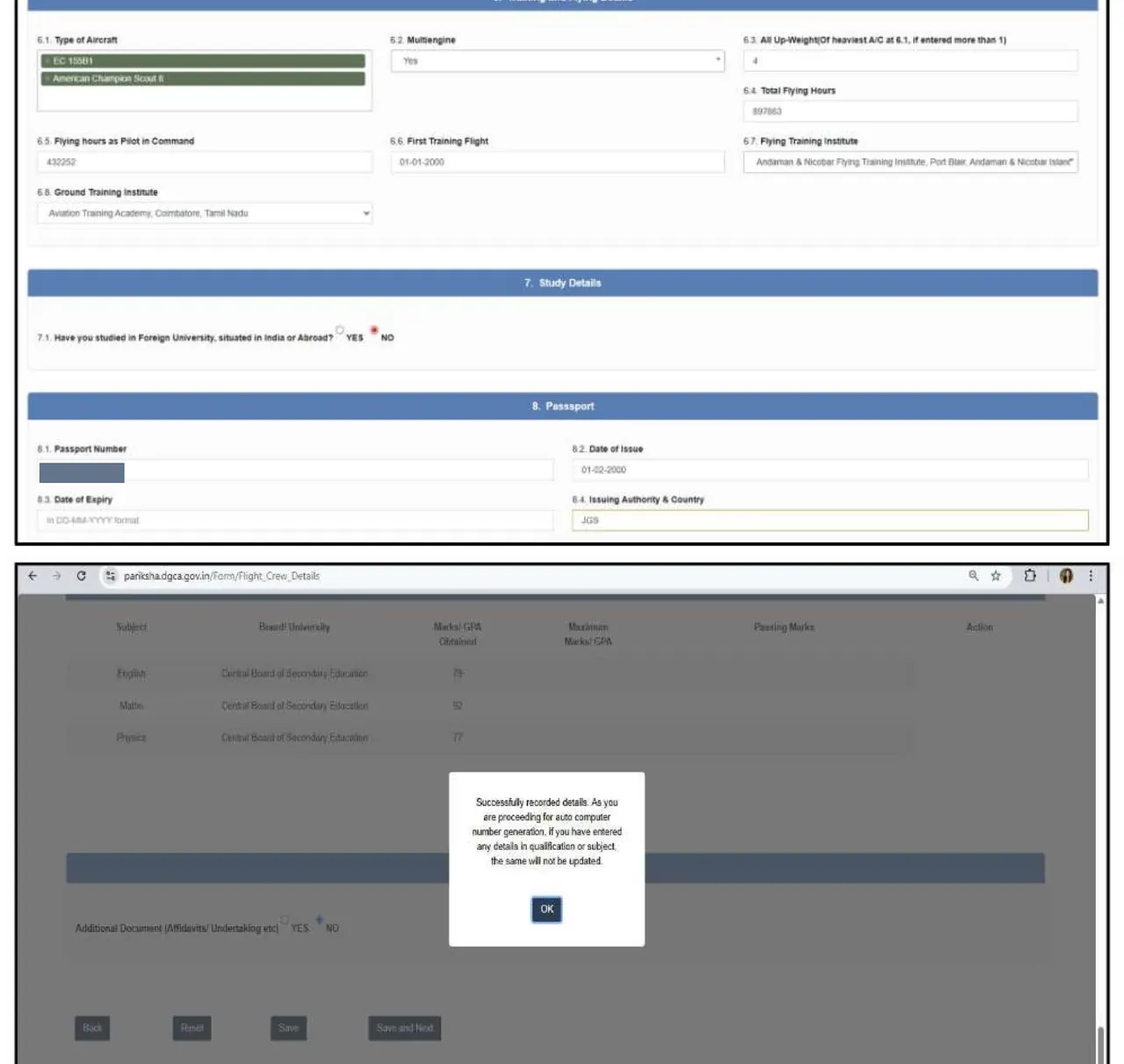
Check the Class 10 and Class 12 entries against your documents, including the board, qualification name, duration where displayed, subjects and marks. Click Save and Next once the records match. If a confirmation appears, read it and click OK. Check the fetched values before you proceed, since the automatic route may disregard edits to qualification or subject data.
7. Review fetched documents and upload the remaining files
On the document page, review the list of files fetched from DigiLocker. Check each document against your records, then upload the photo, signature, address proof and any other documents still requested by the portal.
Photograph and signature upload specifications
| Upload | Dimensions and background | Format and limit |
|---|---|---|
| Colour photograph | 45 mm high × 35 mm wide. Face 35 mm high × 25 mm wide, about 70% of the photograph. White background without borders. | JPEG/JPG, up to 70 KB |
| Scanned signature | 20 mm high × 45 mm wide. White background without borders. | JPEG/JPG, up to 20 KB |
Acceptable
45 mm high × 35 mm wideFace 35 mm × 25 mm
- Recent colour photograph, facing the camera
- Plain white background, no borders
- Signature in black or blue ink on plain white paper
Not acceptable
- Selfie-type photograph or sunglasses
- Face turned to the side or looking down
- Signature written in all capitals
- Dark, smudged or too-small signature
- Faint or incomplete signature
DGCA Pariksha Flight Crew User Manual
8. Review and submit your application
After uploading the remaining documents, click Save and Next. On the review page, check your personal details, education records and uploaded files. If everything is correct, click Final Submit.
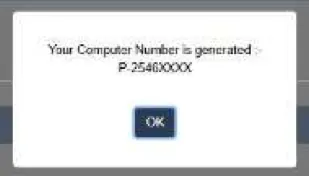
If the automatic checks pass, Pariksha displays your DGCA Computer Number and sends a confirmation to your registered email address. Save the number and keep the email for future reference.
Apply for your DGCA Flight Crew Computer Number through the manual route
Choose No at the DigiLocker auto-generation prompt if you do not meet the criteria for automatic generation. DGCA officers review your application and supporting documents online. The Flight Crew FAQ says you do not need to post a hard copy of the application form. The original BVC may still need to reach DGCA, depending on who it is addressed to.
1. Prepare your documents before registering
Scan every required document before you begin. Once you select Final Submit, you cannot add an omitted file unless DGCA returns the application for correction.
- Photograph. Upload a recent colour JPEG/JPG, less than three months old, up to 70 KB. Use a matte photograph measuring 45 mm high × 35 mm wide on a plain white background without borders. Your face should occupy about 70% of the photograph.
- Signature. Sign in black or blue ink on plain white paper. Upload a borderless 20 mm high × 45 mm wide JPEG/JPG, up to 20 KB.
- Class 10 records. Prepare both the marksheet and pass certificate as PDFs. Check the date of birth against your Class 10 certificate.
- Class 12 records. Prepare both the marksheet and pass certificate as PDFs. Your qualifying records must show that you passed Physics and Mathematics through a recognised board or university. Diploma holders should also prepare the applicable 10+2 equivalence certificate.
- Identity and permanent address proof. Prepare self-attested PDF copies of acceptable proof, such as Aadhaar, a valid passport or voter ID. Foreign nationals must provide a passport and follow the security clearance procedure using Annexure A.
Board Verification Certificates for Class 10 and Class 12
Arrange verification from each issuing board. Follow the instructions for the addressee on your Board Verification Certificate (BVC). If your board offers online verification that DGCA can access, see the accepted alternative in Step 4.
For what to submit for each addressee, see How to submit the BVC in Step 4.
2. Complete the online application
- Open Flight Crew registration. Open DGCA Pariksha, click Click Here To Proceed, then choose New Candidate Registration under Flight Crew. Read the instructions, tick the declaration and submit it. Open DGCA Pariksha
- Select the manual route. At the DigiLocker automatic-generation prompt, click No to open the manual registration form.
- Register and activate your account within 24 hours. Enter your name and date of birth exactly as shown on your Class 10 certificate. Use a personal mobile number and email address that are not shared with another candidate. Complete the mobile OTP and email verification. Open the activation link and set your password within 24 hours. If the link expires, register again as directed by the portal. Keep your Temporary ID.
-
Sign in and complete the profile tabs. Go to Flight Crew → Candidate Login and use the credentials shown or sent by Pariksha. Select CPL and click Save & Next as you complete each tab.
- Personal details. Check your parents’ names, gender, nationality and Aadhaar details against your documents wherever applicable.
- Addresses. Enter your permanent address exactly as printed on the proof you upload. Add your correspondence address separately if it differs.
- Education. Enter the Class 10 and Class 12 roll numbers, boards, passing years and relevant subject marks, including Physics and Mathematics.
- Flying, licence and passport details. Answer according to your circumstances. Select No if asked whether you hold a licence and you do not have one. Complete training and passport fields where applicable.
- Upload and preview your documents. Upload your photograph and signature as JPEG/JPG files and the remaining documents as individual PDFs. Click View beside each upload to check that the scan is sharp, upright and complete.
- Review, submit and track. Review the read-only preview, tick the final declaration and click Final Submit. Save the acknowledgement and check the application status through Candidate Login using your Temporary ID. While the application is under scrutiny, look for requests for corrections. If approved, DGCA emails your permanent Flight Crew Computer Number, which starts with P-.
DGCA Flight Crew FAQs · DGCA Flight Crew User Manual
Step 7. Set your pilot training budget
Before you choose a training route, sit down with your parents and have a frank conversation. How much can the family contribute, how much would you need to borrow and what is the maximum you can afford if training takes longer than planned? Agree on a ceiling together and respect it.
Compare the two routes using the full cost
| Training route | Planning estimate | What to check |
|---|---|---|
| Indian airline cadet programme | ₹1 crore to ₹1.7 crore | Check which stages the package covers, including CPL, type rating, accommodation, travel and any training or induction charges. |
| Self-sponsored CPL | About ₹80 lakh to ₹85 lakh, including type rating | The total depends on the flying training organisation and country. If you train abroad, check licence conversion, exchange rates and travel. Ask what extra flying hours and retests cost. |
These are my planning estimates for 2026. Ask for an itemised quote and payment schedule for the exact programme you are considering. Add living costs and a buffer for delays before deciding whether it fits your budget.
Work out how you will fund each stage
- Family contribution. Agree on the amount your parents are comfortable committing and when it will be available. Give them room to be honest about their limits.
- Bank education loan. Ask whether the lender funds your exact course and training organisation. A cadet programme may have a financing partner, but approval and collateral requirements depend on the lender. If you plan to mortgage property, ask for the lender’s assessed value and maximum sanction in writing. For an initial budget, you can model borrowing at roughly 75% of the lender’s assessed property value. Check what your budget looks like at a lower percentage too, since the actual sanction depends on the lender and loan product. There is no standard 80% of market value rule. SBI’s published loan-against-property limits are 65% for loans up to ₹1 crore and 60% above ₹1 crore up to ₹5 crore. Education loans have separate collateral rules. For example, Bank of Baroda’s Gyan education loan specifies collateral equal to 100% of the loan amount where that condition applies. SBI loan against property · Bank of Baroda Gyan education loan SBI education loan FAQs
- Family, friends or an NBFC. If there is a funding gap, discuss whether family or friends can help on terms everyone understands. You can also ask non-banking financial companies about unsecured options based on a parent or co-borrower’s income and credit profile. Compare the interest rate, fees, interest during training and total repayment.
- Air India cadet financing. Several cadets I’ve worked with have used collateral-free financing of up to ₹50 lakh through the Air India cadet programme. If you are selected and need to cover a funding gap, ask for the current offer and confirm your sanction amount, interest rate, fees and disbursement schedule directly with the lender. Air India Cadet Pilot Programme course details
Before paying a substantial deposit, you should know your family contribution, the loan amount you can actually secure and how you will pay each instalment, including any gap between finishing training and starting work.
Scholarships and funding support
Genuine pilot training scholarships are limited. I haven’t found a nationwide CPL scholarship open to all eligible applicants regardless of gender or state of residence.
- Honda India Foundation has funded commercial pilot training for selected women from Gujarat, Haryana and Rajasthan. Honda India Foundation CSR report
- IndiGoReach’s Giving Wings to Fly supports eligible Indian women from economically disadvantaged backgrounds and includes CPL and ATR type-rating training. Giving Wings to Fly
- Boeing Sukanya has supported selected women through Air India Flight Training Academy. Boeing programme announcement
A word of caution for students and parents. Some advertisements use “scholarship” to market a fee discount. Ask for the award terms in writing, including who funds it, what it pays for and what your family still owes. Count it in your budget only after you receive written confirmation.
Step 8. Choose a ground training institute for your DGCA exams
Ground school is where you prepare for your DGCA exams and meet instructors who can become mentors. Visit a regular class and speak to former students before deciding.
- Track record. Ask when the academy began conducting DGCA classes. An operation that has sustained training for 15 years or more is worth examining. Ask for dated evidence and look at how the academy performs today.
- Discipline. Check how the academy handles punctuality, attendance, preparation and missed assignments. Look for the standards you’ll need as a pilot, including good rest habits and integrity.
- Verifiable results. Ask for the numbers enrolled, appeared and passed, by subject and exam session. Ask how many passed on the first attempt and whether the academy can substantiate the results through roll-number-wise records with student consent or anonymised evidence.
- Batch size. I recommend no more than 40 students, including online participants in a hybrid batch.
- Instructor experience. Look for at least three years of teaching experience alongside relevant commercial flying experience. Ask who will teach your batch and sit in on a class.
- Faculty stability. Ask who will teach each subject from the first class through revision and how instructor changes are handled.
- Soft skills and CRM. Ask to see how instructors teach and debrief exercises in leadership, conflict resolution, situational awareness and teamwork.
- Support after ground school. Ask former students what help they received through flying training and airline selection. Find out who provides it, how long it lasts and which services carry a fee.
Step 9. Choose and plan your pilot training pathway
Keep three decisions open when you start ground school. Will you take the cadet route or a self-sponsored CPL? Which airline programme suits you? Which Flying Training Organisation (FTO) should you choose?
Research early and use ground school to build your own judgement. Talk to instructors, classmates and people further along in training. Ask what they spent, how long it took and what they would do differently. Advice from a friend or a pilot is shaped by their own experience. Find a mentor you trust who understands your circumstances and can help you evaluate conflicting advice.
A wrong choice can cost money and set you back by years. Make your decision with your family once you can explain how it fits your own budget, timeline and goals.
Compare airline cadet pilot eligibility
Check the current intake’s age cut-off dates, education rules and medical deadlines before paying an application or assessment fee.
IndiGo Cadet Pilot Programme
An airline-linked pathway to a CPL and Airbus A320 type rating through approved flying training organisations in India and overseas.
- Education. At least 51% individually in Class 12 Physics, Mathematics and English. Check the intake notice for any aggregate requirement.
- Age. Minimum 18 and maximum 40. Confirm the date used to assess your age.
- Medical and fitness. DGCA Class 1 before training. Confirm whether initial applications can use Class 2 and check any height, cockpit-reach or BMI documentation requirements.
- Nationality. Indian citizens and OCI holders, subject to passport, visa and right-to-work requirements.
IndiGo cadet programme overview
Air India Cadet Pilot Programme
A pathway for applicants with no prior flying experience, with CPL training followed by type rating. Check the aircraft type and training location for your intake.
- Education. 60% overall in Class 12 and 60% individually in English, Mathematics and Physics. Air India accepts the NIOS route for applicants completing Class 12 Mathematics and Physics.
- Age and height. 18–30 years and minimum height of 158 cm in the published intake criteria.
- Medical. DGCA Class 1 before flight training.
- Nationality. Indian citizens and OCI holders in the published intake criteria.
Air India programme eligibility · Air India Aviation Academy intake criteria
Akasa Air SkyCadet Pilot Training Programme
- Education. Check the intake notice for Class 12 subject requirements, English proficiency and any minimum percentage.
- Age. The published listing gives a maximum of 40 at enrolment. Check the minimum age and the applicable cut-off date.
- Medical and nationality. Partner guidance lists a minimum DGCA Class 2 medical and Indian passport eligibility. Check the current intake for citizenship, Class 1 timing, fitness and background documentation.
flydubai Ab Initio Pilot Training Programme
A UAE Multi-Crew Pilot Licence (MPL) pathway. flydubai describes it as self-funded for non-UAE nationals.
- Education and English. High school completion with at least 70% or a GPA of 3.0, and fluent written and spoken English.
- Age. 17–30 years.
- Medical. Ability to obtain UAE GCAA Class 1 medical certification.
- Height. The public listing gives no explicit height cut-off. My guidance is to use 160 cm as the practical minimum and confirm it directly with flydubai before paying an assessment fee.
flydubai eligibility and applications
Air Arabia Academy MPL Cadet Programme
An airline-linked UAE MPL pathway based in Sharjah.
- Education. High school or equivalent. Check the intake criteria for Indian Class 12 marks and the Mathematics, Physics and English selection assessments.
- Age. Available assessment material lists 17–34 years. Confirm the current upper limit and the date it applies.
- Height. Air Arabia Academy’s public admissions information does not list a minimum height for this programme. Confirm the current intake’s fitness requirements with the academy.
- Medical and nationality. Programme materials list UAE GCAA Class 1. Indian applicants should confirm current eligibility, passport, visa and security-clearance requirements with the academy.
Air Arabia Academy MPL enquiry
Before paying. Ask for the full cost, licence issued, training location, type rating, and induction terms in writing. If you plan to fly in India after training abroad, verify the Indian licensing route before committing to a UAE MPL.
Self CPL pathway (conventional)
If you choose the self-sponsored Commercial Pilot Licence (CPL) route, start looking for a Flying Training Organisation (FTO) while you’re still in ground school. By the halfway point, aim to settle on your pathway with your mentor and family. Work backwards from your intended flying start date. By the end of ground training, aim to have your FTO enrolment, visa if applicable, and other joining formalities complete. Start early on any step that depends on an outside approval.
I’ve seen students lose six to eight months after ground school and DGCA exams simply getting ready to start flying. That gap can cost you a chance to apply for an airline opening. Sit down with your mentor and family while there’s still time to sort out the school, the budget and the paperwork.
Checklist for choosing a flying school
- Safety record. Review the school’s last three to five years under its legal name and at the base where you’ll train. Look for serious accidents, incidents, recurring problems and any published regulatory action. Ask the school what it changed after significant events and how it handles routine occurrence reporting. An open reporting culture is a positive sign. For a U.S. school, start with the NTSB’s aviation investigation database and use the FAA to verify the school’s certification where applicable. NTSB aviation investigation search · FAA Part 141 pilot schools
- Country and training base. Check living costs, official travel advisories, civil unrest or conflict, and local safety concerns, including harassment or discrimination. Speak to Indian students who have lived near the base. Ask for the last 12 months of flying days and weather cancellations by month. That will show how much flying you can reasonably expect during the season you’ll be there.
- Regulatory documents and aircraft airworthiness. Ask for the school’s applicable training approval or certificate and confirm with the local regulator that it covers your course and training base. Ask for the registrations and airworthiness documents for the aircraft you’ll fly, along with evidence of current maintenance or inspection status. If you train abroad, check with DGCA how your syllabus, logged flying and tests will count towards Indian licence conversion before you commit.
- Actual completion times. Ask for anonymised start and finish dates for at least five recent graduates from the same course and base. Calculate their average and look at the range. Ask how many students from those intakes are still training or left. Speak independently with graduates and current students, including through social media, and ask what caused delays. Compare what they tell you with the advertised schedule.
- Aircraft type and availability. Ask which aircraft you’ll actually fly, such as a Cessna 172 or a Piper, and whether they have conventional instruments, glass cockpits or a mix. If you’ll need conversion flying in India, verify with Indian schools that they have suitable aircraft and available slots. Divide the number of active students at your base by the number of serviceable aircraft available to their course. For example, 40 active students and eight available aircraft means five students per aircraft. Judge that ratio against actual flying hours per student each month, instructor availability and maintenance downtime. Check single-engine and multi-engine capacity separately if your course uses both.
- Total cost and family budget. Choose an affordable school that meets your safety and training requirements. Compare written totals including extra flying hours, tests and retests, accommodation, visa and travel costs, and any Indian conversion costs. Ask what is refundable and when payments are due. The conventional route has no fixed employment timeline, so agree on a budget your family can carry through training and a period without income.
- Completion target. I’d aim to finish flying training in about 14 months and budget for a few months of variation. If a school says you can finish earlier, ask for recent completion records and evidence of the aircraft, instructor and test slots needed to support that timeline. “Ho jayega” is easy to say. Ask the school to show you how it will happen while keeping normal training and safety standards.
- Professionalism and fair rostering. Ask how flying slots are allocated, how cancelled sorties are rescheduled and who handles a complaint when a student repeatedly misses out. Ask to see an anonymised roster and speak privately with current students about whether the school follows its own scheduling rules or gives preferential treatment.
Why a month mattered in my career
Jet Airways announced an opening in June 2007. I completed my flying training in July. Several of my friends got through that hiring round. Kingfisher later collapsed, and I ended up waiting about seven years for a flying job. I still remember missing that opening by a month. Get the decisions and paperwork you can control moving early, so you’re ready to apply when an opening comes.
Realistic timeframe before you start earning as a pilot
You’ll see reels and advertisements promising that you can become a pilot in 10 or 12 months. Ask what that clock covers. It may cover the flying phase alone. I tell students and parents to budget from the day ground school begins to the day the airline starts paying you.
Here’s how I would plan for an airline cadet programme that sends you overseas for CPL flying and brings you back to India for conversion. The figures are planning estimates for this sequence. Check the stages, timing and pay terms for your own intake in writing.
| Stage | Time to allow |
|---|---|
| Ground training and DGCA exam preparation | 6–8 months |
| Wait for a cadet intake and complete selection | Varies with the opening and assessment schedule |
| FTO preparatory training before flying | Allow 4 months if your programme includes this phase |
| Visa processing and FTO batch allocation | Allow 4 months or more |
| Overseas flying training | 15–18 months, depending on the FTO and country |
| Conversion flying after returning to India | 3–4 months |
| Indian CPL issuance | Allow at least 1 month |
| Wait for a type-rating slot | 2–3 months |
| Type-rating training | About 2 months |
| Type-rating endorsement on the licence | About 1 month |
| Wait for airline induction | Budget about 6 months, with room for a longer wait if airline requirements change |
| From joining to release as a Junior First Officer | Allow about 8 more months in this scenario. Check when any stipend begins and when Junior First Officer pay takes effect under your contract. |
Illustrative timeline from ground school to airline pay
If the timed stages run one after another, they add up to roughly 44–51 months to joining, plus the time spent waiting for a cadet opening and completing selection. Some steps can overlap, and delays can extend the total. I would use about four years as a starting point when budgeting for your first stipend, where the airline pays one from joining. In this example, budget about eight more months from joining to release as a Junior First Officer and plan for that pay based on your written terms.
If you choose the conventional Self CPL route, use the stages that apply to you and allow separately for the airline job search. That wait can vary considerably. Before your family commits, make sure the budget can carry you through training and the wait for the first payment.
DGCA exams for the CPL: subjects, pass marks and validity
You need to pass five papers: Air Regulations, Aviation Meteorology, Air Navigation, Technical General and RTR. On top of these there is a Technical Specific paper for the trainer aircraft you will fly.
| Paper | What it covers |
|---|---|
| Air Regulations (Air Law) | The rules of the air. Just as there are rules for driving, there are rules for flying. |
| Aviation Meteorology | Understanding and interpreting weather so you can fly through it safely. |
| Air Navigation | A large syllabus in three parts. General Navigation covers calculations such as drift, track, rate of climb and descent, and payload. Radio Navigation covers the aids that take you from A to B or down an approach, such as VOR and ILS. Instrumentation covers the instruments on board, such as the attitude indicator. |
| Technical General | How an aircraft flies, its powerplant and its systems. |
| RTR | Radio telephony, in two parts: a theory exam and a practical test. |
| Technical Specific | The aircraft type you will train on. |
Write Technical Specific after you choose your FTO. If your school flies the Cessna 172, you write the paper for the C-172, not for a Piper or a Diamond.
How the exams are held
DGCA conducts the exams online at a centre it assigns to you. Each paper carries 100 marks, the pass mark is 70%, all questions are multiple choice and there is no negative marking. A passed CPL paper stays valid for five years.
There are two kinds of attempt. The general attempt is held every three months and costs ₹2,500 per paper. The special attempt is held every month except the months with a general attempt and costs ₹5,000 per paper. Confirm current dates and fees on Pariksha before you apply.
RTR is also conducted by DGCA, in two parts. Part 1 is a theory exam, like the other papers. Part 2 is a practical test, where an examiner plays the role of ATC and you play the pilot. The examiner takes you through a full flight, from engine start to cruise, and creates different situations along the way, expecting the standard call for each one. You must pass both parts; your licence is issued only after both are complete.
Which papers to take first
Difficulty is personal, but over the years I have seen students struggle most with Navigation and Technical General. I suggest taking these first. You have just left school and still have the habit of studying, and you are starting out full of confidence. Clearing the hard papers early reduces pressure and builds that confidence further.
A serious candidate should finish all papers within six to eight months. Anything beyond that points to a lack of effort from the candidate or the ground school.
If you fail a paper
There is no limit on the number of attempts, but a fail brings a 45-day cooling period for that paper. If you fail Navigation, you cannot write Navigation in the next attempt; your other papers are not affected. Write a paper only when you are fully prepared. Sitting one just to see the pattern hurts you twice: your morale drops and your next attempt is blocked.
The “I only failed by two marks” trap
Most failures I see fall between 62 and 70. A student comes to me and says, “Sir, I got 68. Next time I only need two more marks.” In truth that student is still missing 32 marks. They prepare only a little more, and the next score drops to 62 or 60. I have seen people fail four or six times in this band. It can set you back a year or more, and it damages morale so badly that students start asking whether they should continue at all.
If this happens to you, go back to the whole syllabus and study it from scratch.
For Navigation and Technical General, do not stop at theory. Practise different kinds of questions every day from the start. You may know the theory and still fail to apply it, because a multiple-choice question can be confusing and its author may think differently from you. Practice teaches you how to reason your way to the answer.
RTR(A): preparing for the radio telephony exam
Clear your RTR during ground training itself. Leaving it for later will only delay the issue of your licence. Preparation normally takes about 45 days.
For Part 2, the practical, you will learn how each call is structured. After that it comes down to practice, and a lot of it. Sit with a colleague, let one of you act as ATC and the other as the pilot, and run through the calls again and again.
There is a lot of misinformation about accent. Radio in line operations is a normal conversation between ATC and the pilot using standard terminology. Focus on the standard terminology, not on putting on a particular accent.
If you fail either part, you can reappear for it after the 45-day cooling period. Your Part 1 pass stays valid for three years. If you have not cleared Part 2 within that time, you must write Part 1 again.
Flying hours and requirements for CPL issue
Two hundred hours is only the headline. Under Schedule II, Section J of the Aircraft Rules, DGCA splits those hours into categories, flying tests and six-month windows. Miss one, or let a test expire, and your licence can be delayed by months and cost lakhs in extra flying.
All 200 hours must be completed within the five years immediately before the date of your CPL application. Every sub-requirement sits inside the 200 hours, not on top of it.
Minimum flying hours
The bare CPL needs 200 hours, but virtually every Indian airline expects you to hold an Instrument Rating (IR) when you apply. Plan your flying around the CPL with Instrument Rating column from day one, so you do not pay for top-up hours later.
| Flying requirement | Basic CPL minimum | CPL with Instrument Rating | What to check in your logbook |
|---|---|---|---|
| Total flying time | 200 hours | 200 hours | Logged within the five years before the application date. |
| Pilot-in-Command (PIC) | 100 hours | 100 hours | Includes solo flying and properly endorsed supervised PIC (SPIC). |
| Cross-country as PIC | 20 hours | 50 hours | Must include one 300 NM PIC cross-country with full-stop landings at two different aerodromes. Every qualifying leg must be at least 100 NM. |
| Instrument time | 10 hours | 40 hours | For the IR: at least 20 hours in an actual aircraft, with a maximum of 20 hours on an approved simulator. For the basic CPL: a maximum of 5 hours on a simulator. |
| Night flying as PIC | 5 hours | 5 hours | Actual aircraft only, with no simulator credit. Must include at least 10 take-offs and 10 landings as PIC. |
Watch the 100 NM rule. Each cross-country leg must be at least 100 NM, wherever in the world you train. If your school abroad counts 50 NM legs as cross-country, those flights will not count for DGCA. Tell your instructor before you start the cross-country phase.
Mandatory skill tests
Before you apply on eGCA, you must pass four CPL flight tests with a DGCA-approved examiner, plus the IR and Multi-Engine tests if you are adding those ratings.
- General Flying Test (GFT) by day. Not less than 45 minutes, covering general handling, stalls, steep turns, circuits and simulated forced landings.
- General Flying Test (GFT) by night. Not less than 45 minutes, covering night circuits, take-offs, landings and emergency procedures.
- Day cross-country flight test. At least 250 NM as PIC, including at least one full-stop landing at an aerodrome other than your departure aerodrome.
- Night cross-country flight test. At least 120 NM as PIC, returning to your aerodrome of departure without landing elsewhere.
- Instrument Rating and Multi-Engine skill tests. Required if you are applying for those endorsements with your CPL.
What must be valid on the day you apply
Flying hours alone do not get you the licence. On the date you submit your CPL application on eGCA, all five of these must be valid.
- Age. At least 18 years.
- DGCA theory papers. Valid passes in Air Regulations, Aviation Meteorology, Air Navigation, Technical General and Technical Specific for the aircraft type used in your skill test. Passes stay valid for five years.
- Class 1 medical. A valid DGCA Class 1 medical assessment.
- RTR(A). A valid Radio Telephony Restricted (Aero) licence issued by DGCA, with both Part 1 and Part 2 passed.
- English Language Proficiency (ELP). At least ICAO Level 4 endorsed on your records. Level 4 is valid for three years, Level 5 for six years and Level 6 for life.
The six-month recency rule
This is the rule that catches the most students off guard. Some hours and all skill tests count only if they fall within the six months immediately before you submit your CPL application.
- 15 hours of PIC flying within the preceding six months.
- All 5 hours of night flying as PIC, including all 10 night take-offs and 10 night landings, within the preceding six months.
- All CPL, IR and Multi-Engine skill tests passed within the preceding six months.
- At least 5 hours of instrument time on an actual aircraft within the preceding six months, if you are applying for an Instrument Rating.
Say you finish your night flying and skill tests in January, and your RTR or Class 1 renewal drags on until August. Your night flying and tests have expired. You will pay to fly them again before DGCA looks at your file.
Extra flying and tests if you trained abroad
If you hold a valid CPL issued by an ICAO Contracting State, such as the FAA in the USA, SACAA in South Africa, CASA in Australia or the CAA in New Zealand, you can convert it to an Indian CPL. Both your foreign CPL and your foreign Class 1 medical must be valid on the day you apply to DGCA.
- Conversion theory exams. Pass the DGCA Air Regulations paper and the Composite paper (Air Navigation and Aviation Meteorology), plus Technical Specific if applicable.
- Conversion flying and skill tests in India. Even though you passed checkrides abroad, DGCA requires you to fly all four CPL skill tests again (day GFT, night GFT, 250 NM day cross-country and 120 NM night cross-country), plus your IR skill test, at a DGCA-approved FTO in India on an Indian-registered aircraft, within the preceding six months.
- Top-up flying for any DGCA shortfall. If your foreign logbook falls short of the 100 NM cross-country rule or the night take-off and landing recency, you must fly those hours before you submit your conversion file.
What delays CPL issue most often
In my experience reviewing student files at GEA, almost every delay comes down to paperwork or sequencing that could have been avoided.
- Flying skill tests before your papers and RTR(A) are ready. Get your Class 1 medical, DGCA exam passes and RTR(A) in place before you schedule your final skill tests, so the six-month clock does not run out while you wait on something else.
- Waiting until you return to India to request foreign licence verification. DGCA verifies your foreign CPL and hours with the authority that issued them. I have seen this take anything from one week to ten weeks. Send the request before you fly home, keep your school informed and ask them to follow up so the reply comes faster.
- Uncertified logbooks or eGCA mismatches. Every page of your physical logbook and your CA-39, the DGCA form where you summarise your PIC, dual and solo flying, must be signed and stamped by your FTO’s Chief Flying Instructor (CFI). The totals must match your eGCA e-Logbook entries down to the minute.
- Expired aircraft or examiner approvals on checkride day. Before any skill test, ask your FTO to confirm that the aircraft’s Airworthiness Review Certificate (ARC) and the examiner’s DGCA approval are both valid on that date.
Pilot salary in India: Junior First Officer to Senior Captain
Before a family commits ₹80 lakh to ₹1.7 crore to training, they want to know what comes back once you are in the cockpit.
Airline pay in India is not a flat monthly salary. Most airlines pay a fixed monthly amount tied to a guaranteed block of 40 to 70 flying hours, plus an hourly flying allowance for every hour above that, along with layover allowances and overtime. Rosters change from month to month, so two pilots of the same rank at the same airline can take home noticeably different amounts.
Indian airlines do not publish their pay scales. The figures below are my planning estimates for 2026. Confirm current pay and contract terms in writing at the time of your intake.
Pay progression by rank
The biggest jump in a pilot’s career comes at command upgrade, when you move from the right seat as a Senior First Officer to the left seat as a Captain. How long that takes depends on the airline. At IndiGo you can get command in four to five years, six at most. At Air India and Akasa Air it is about seven to eight years.
| Rank or career stage | Typical experience | Indicative monthly in-hand pay | Key milestone |
|---|---|---|---|
| Trainee (stipend phase) | Ground, simulator and line training, 0–8 months | ₹50,000 – ₹1.0 lakh | Training stipend before release; varies by airline |
| Junior First Officer (JFO) | 0–1 year after release, under 1,000 hours | ₹1.2 – ₹1.8 lakh | Released to fly commercial sectors with a Captain |
| First Officer (FO) | 1–3 years, 1,000+ hours on type | ₹2.2 – ₹2.5 lakh | Step-up in base pay and hourly flying allowance |
| Senior First Officer (SFO) | From about 3 years until command, ATPL cleared, 2,500–3,000+ hours | ₹3.0 – ₹3.5 lakh | Eligible for command upgrade assessment |
| Captain (narrow-body, A320 or B737) | 4–6 years at IndiGo; 7–8 years at Air India and Akasa Air | ₹5.5 – ₹6.5 lakh | Command, and the largest single jump. A newly released Captain gets roughly ₹5.5 lakh in hand. |
| Senior or Training Captain (narrow-body) | Experienced Captain, LTC, TRI or TRE | ₹7.0 – ₹8.0 lakh+ | Check and instructor pay |
These are in-hand figures for narrow-body flying in India. Wide-body and overseas pay is higher.
How airlines structure pay
- IndiGo. Builds its package around a committed 70-hour monthly flying block, with overtime if your roster crosses that mark. Its large narrow-body fleet has historically offered one of the fastest routes to command.
- Air India and Air India Express. Fix base pay around a 40-hour flying block and pay tiered hourly flying allowances beyond 40 hours. Senior captains who move to the wide-body international fleets sit at the top of the pay scale.
- Akasa Air. Pays a fixed base tied to 40 flying hours, with stepped hourly flying allowances above 40 and 70 hours on its Boeing 737 MAX fleet.
- Regional, cargo and charter operators. Turboprop and regional carriers generally pay less at entry level than narrow-body jet airlines. Cargo airlines and corporate jet operators mostly hire experienced commanders on competitive senior packages.
What to keep in mind when you weigh salary against the cost
- In hand and gross are different. The figures above are in-hand estimates. Airline offers are quoted as gross pay, so check what reaches your account after tax. Middle East carriers are different, as salaries there are generally tax-free.
- Loan repayment. The first years are difficult. As a Junior First Officer and First Officer, most of what you take home goes to living costs and loan EMIs. It gets easier with each step up, and real savings begin after you upgrade to Captain.
- Benefits beyond salary. Scheduled airlines typically provide loss-of-licence insurance, family medical cover, staff travel, and hotel and layover allowances on outstation duties.
Can you become a pilot without Physics and Mathematics in Class 12?
Yes, there is a way. If you did not take Physics and Mathematics in Class 12, enrol with the National Institute of Open Schooling (NIOS) for the subject you are missing, or for both.
How long it takes depends on when you start. NIOS holds exams frequently, but if the next exam is in July and you decide in January, you will wait longer than someone who decides in June. After you write the exam, allow about three months to receive your marksheet and complete board verification. Once you have it, you can apply for pilot training on the basis of the NIOS marksheet. It is accepted for the DGCA Computer Number and for airline cadet programmes.
Board verification can be the hard part. With CBSE, ICSE and NIOS it is usually simple. With some state boards the process is not clearly laid out, and you end up running from pillar to post just to find out what it is. Some boards also ask for a document explaining why you need the verification. You have two ways to handle this: show them the DGCA notice that asks for board verification, or ask your ground training academy to issue a letter requesting the board to verify your marksheet for this purpose, in your name or addressed to DGCA, as explained in Step 4.
Check your Class 10 marksheet carefully. DGCA accepts only the Class 10 marksheet for your date of birth and personal details. Any error in it stops your Computer Number application completely, and a name mismatch will cause problems with airlines later too. Get it corrected before you apply.
If you are choosing subjects in Class 11: if you are sure you want to be a pilot, take Physics and Mathematics from the start. It is a regulatory requirement and it gets you to your goal directly. If you find them too difficult, continue with the subjects you like and take the NIOS route after Class 12. That is the practical way.
Frequently asked questions
How much does it cost to become a pilot in India?
Plan for about ₹80–85 lakh for a self-sponsored CPL including type rating, or ₹1–1.7 crore through an Indian airline cadet programme. These are planning estimates. Ask for an itemised quote, then add living costs and a buffer for delays.
How long does it take to become an airline pilot in India?
On an overseas cadet route, plan about four years from the first day of ground school to your first airline stipend, and about eight more months to release as a Junior First Officer. Advertisements that promise 10 or 12 months usually count the flying phase alone.
What is the minimum age and qualification to become a pilot?
You must be at least 18 on the date you apply for your Commercial Pilot Licence, and you must have passed Class 12 or an equivalent examination with Physics and Mathematics from a recognised board. You also need a DGCA Class 1 medical.
Can I become a pilot after 12th?
Yes. Class 12 with Physics and Mathematics is the qualification you need. You can do your initial Class 2 medical before, during or after Class 12, and you must be 18 on the date you apply for your CPL.
Can I become a pilot without Physics and Mathematics in Class 12?
Yes. Enrol with NIOS for Physics, Mathematics or both. The NIOS marksheet is accepted for the DGCA Computer Number and for airline cadet programmes.
Do I need a college degree to become a pilot?
Many parents ask me to let their child finish a degree first as a backup. My opinion is different. Flying is a skill, and your skills and hand-eye coordination are better the younger you are. Put an 18-year-old and a 55-year-old behind the wheel of a car and the younger one reacts faster. If a degree were that important, the regulator would have made it a requirement, and the requirement is 10+2. If you want to become a pilot, start as early as you can. How long you fly after that is up to you.
Is there an upper age limit to become a pilot?
There is no upper age limit to become a pilot. The issue is that airlines mostly hire young pilots. Air India takes cadets only up to 30, IndiGo takes cadets up to 40, and hiring of CPL holders normally goes up to 35. Treat 30 to 35 as the practical limit.
Can girls become pilots in India?
Yes. India is one of the best countries in the world for women pilots today. By percentage, India has the highest share of women pilots of any country. The United States has more women pilots in number, but India leads in percentage. In the cockpit there is no discrimination at all. Women pilots are as competent and as professional as any male pilot.
Can I become a pilot if I wear spectacles?
Yes. Your eyesight should be 6/6 with or without correction. The power of your glasses does not matter. Your DGCA medical examiner makes the assessment.
Is colour blindness a bar to becoming a pilot in India?
Yes. Some countries issue a conditional flying licence for certain kinds of colour blindness. In India, if you are applying as a fresher, colour blindness is not acceptable.
I am short. Can I become a pilot?
Yes. DGCA sets no height requirement as such. What can happen is this: at your Class 1 medical, if you are under 150 cm or clearly appear too short, the medical board may ask you for a cockpit test certificate. They simply want to confirm that your legs reach the controls and that you can move them comfortably. You can get this done in two ways. Approach a flying school, sit in the aircraft and have the Chief Flying Instructor issue the certificate. Or ask the medical board whether the test can be done in a simulator; if the board allows it, an organisation with an Airbus or Boeing simulator can run the test and issue the certificate. That is the DGCA side. Airlines set their own rules. IndiGo has no height requirement as such, so at most you may be asked for this test. Air India requires 158 cm, for flydubai plan on 160 cm, and other airlines may have their own limits. So it varies from airline to airline, but there is no DGCA height requirement.
What happens if I fail my Class 1 medical?
First find out whether you are temporarily or permanently unfit. If it is temporary, for a few weeks or months, get the problem treated and go back for your Class 1. If it is permanent, file an appeal. See senior doctors at good hospitals and get their written opinions on the condition that disqualified you. Take at least two or three opinions. If they say you are fit, submit them with your appeal. The DGCA panel will study your case, and if it is a good one you may be declared fit.
What is a DGCA Computer Number and how do I get one?
It is the number DGCA issues through its Pariksha portal, and you need it to write the DGCA exams. If you are an Indian national and your Class 10 and Class 12 records are available in DigiLocker, Pariksha can generate it automatically. Otherwise you apply through the manual route with board verification.
Should I clear my DGCA exams before joining a cadet programme?
In my opinion, yes, for four reasons. First, airlines limit your attempts once you are a cadet. Some allow a maximum of two attempts and some give you six months to clear your papers. That limit puts you under pressure, and if you keep failing it can lead to administrative action, even termination. Second, clearing the exams gives you the knowledge to make your own decisions, so you are not depending on what others tell you. Third, you walk into the cadet interview more confident and better prepared. Fourth, it removes the risk. Outside a cadet programme there is no limit on attempts, and you also save a little time, because the airline and the FTO can move you to flying sooner than someone still waiting on exams.
Will my cadet interview be tougher if I have already cleared my DGCA exams?
No. Over the years I have heard this question again and again. First, if you want to become a pilot, never shy away from questions. This is your passion and what you wanted to do, so why run from it? Second, it simply does not happen. If you have cleared your exams, you are a candidate who has already put in the effort. Third, even if the panel asks technical questions, the result does not rest on them alone. At the interview stage it is more about behavioural questions and your personality, together with how you did in the earlier stages such as the group discussion and ADAPT. Clearing the exams also gives you a chance to show how sound your knowledge is. In my classes, leaving aside the exceptions, most students who had cleared their exams also cleared their cadet interview. This is another rumour, spread by people who want to avoid the responsibility of preparing.
Is the special attempt more difficult than the general attempt?
No. This is the most ridiculous rumour I have ever heard. People keep claiming the special attempt is tougher, and there is nothing like that at all. DGCA has a question database, and the questions for every attempt are picked from it at random. So there is no question of one attempt being tougher and another being easier. These are rumours, and unfortunately they are quite widespread.
Which is better, a cadet programme or a self-sponsored CPL?
Neither is better for everyone. A cadet programme costs more, at ₹1–1.7 crore, and is linked to an airline. A self-sponsored CPL costs about ₹80–85 lakh and has no fixed employment timeline. Neither guarantees a job. Decide with your family once you can explain how the route fits your budget, timeline and goals.
Should I do my flying training in India or abroad?
It depends on when you are asking and on your circumstances. If your resources are limited, train in India. It takes longer, but it is more affordable, because you do not need conversion flying, a visa or the other formalities that come with going abroad. If money is not the constraint, train abroad. It is faster and more professional, but it adds to your cost.
What is the salary of a pilot in India?
In hand, a Junior First Officer takes home about ₹1.2–1.8 lakh a month and a newly released narrow-body Captain roughly ₹5.5 lakh. These are 2026 planning estimates for narrow-body flying in India, and they vary with the airline and the hours you fly.
Is a pilot job guaranteed after the CPL?
No. A job is not guaranteed on either route. After a self-sponsored CPL you wait for a vacancy, appear for the airline’s selection and get the job only if you clear the process. On a cadet programme the job depends on your performance throughout the programme. Neither route guarantees a job.