Pilot Training
Location
Guidance
Capt. Tomar Awdhesh
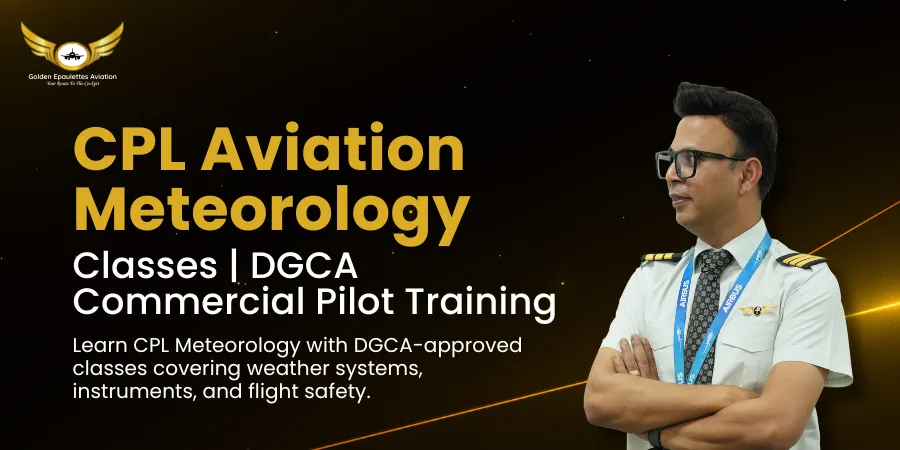
Golden Epaulettes Aviation's ATPL Aviation Meteorology classes prepare DGCA CPL holders and First Officers for the DGCA ATPL Meteorology written paper. The course covers high-altitude weather, jet streams, clear air turbulence, icing, convective hazards, Indian and Gulf climatology and chart decoding over an indicative 6–8 weeks, in Delhi or live online. The paper is conducted by DGCA through the Pariksha portal and has no separate viva.
We will contact you shortly
Thank you for applying. Our aviation expert will reach out to you on WhatsApp with the next steps of your pilot journey.
Go To Home PageAccess the industry's most rigorous DGCA-simulated testing environment.
Cadets Active
196+
Difficulty
Medium
Cadets Active
244+
Difficulty
Medium
Cadets Active
69+
Difficulty
Medium
Cadets Active
136+
Difficulty
Medium
ATPL Aviation Meteorology classes at Golden Epaulettes Aviation prepare CPL holders and serving First Officers for the DGCA Airline Transport Pilot Licence (ATPL) Meteorology paper. The course is for pilots who already hold a Commercial Pilot Licence, are building towards 1,500 hours, and need command-level weather knowledge for the written examination and for airline operations.
Classes run in our Dwarka, New Delhi classroom and live online for pilots across India and the Gulf. The syllabus follows the DGCA ATPL Meteorology paper as examined through the Pariksha portal, with instruction by A320 commanders and DGCA ground instructors.
The ATPL weather subject is not a repeat of the CPL paper. DGCA examines the same atmosphere, but at jet altitudes, over long sectors and with the expectation that you will make the final go/no-go call as a commander. Questions lean towards interpretation, numerical reasoning and operational consequence rather than definitions.
| Topic area | What is examined | Command relevance |
|---|---|---|
| The upper atmosphere | ISA deviations at FL300–FL410, tropopause height by latitude, temperature inversions, density altitude effects on climb and cruise. | Optimum altitude selection, step-climb planning, performance-limited take-offs on hot Indian afternoons. |
| Jet streams and upper winds | Polar-front and sub-tropical jets, core position relative to the tropopause, seasonal shift over India, wind-shear and CAT zones around the core. | Fuel planning on Delhi–Gulf and trans-Himalayan sectors, turbulence avoidance, flight-level requests. |
| Clear air turbulence and mountain waves | Formation mechanisms, horizontal and vertical extent, SIGWX chart symbology, lenticular and rotor cloud cues. | Seat-belt decisions, speed selection in turbulence, routing near the Hindu Kush and Western Ghats. |
| Convective weather | Thunderstorm life cycle, supercells and squall lines, microbursts, hail and lightning, airborne weather radar interpretation and attenuation. | Deviation planning, approach go-around triggers, pre-monsoon operations at northern Indian airports. |
| Icing | Supercooled large droplets, rime versus clear ice, engine and pitot icing, anti-ice versus de-ice logic, holdover concepts. | Winter departures from Srinagar, Leh and northern India; icing in cumulonimbus tops at cruise. |
| Visibility and fog | Radiation and advection fog, RVR versus visibility, dew-point spread trends, low-visibility procedure triggers. | CAT II/III planning at Delhi, Lucknow and Amritsar in December–January; diversion fuel. |
| Tropical and Indian climatology | South-west and north-east monsoon mechanics, ITCZ migration, tropical cyclones over the Bay of Bengal and Arabian Sea, Western Disturbances. | Seasonal route planning, alternate selection along the Indian coasts, Gulf dust storms and Shamal winds. |
| Meteorological codes and charts | METAR, SPECI, TAF, SIGMET, AIRMET, volcanic ash advisories, wind/temperature charts, SIGWX high-level charts. | Pre-flight briefing, in-flight re-planning, dispatch communication. |
Pilots who cleared CPL Meteorology comfortably are often surprised by the ATPL paper. The content overlaps by perhaps half, but the examiner's intent changes.
If your CPL theory is a few years old, our instructors run a short foundation refresher before the advanced modules. You can also revisit our CPL Aviation Meteorology page to check which fundamentals you need to revise.
The course is organised into five modules. Each module ends with a timed DGCA-pattern test, and every wrong answer is debriefed in class so the same concept is not missed twice.
Students receive structured notes, chart packs and access to our online Meteorology test series, which is aligned to the DGCA 2026 pattern. Recorded sessions remain available to online students for revision until their exam session.
Textbooks written for European syllabi spend little time on the weather that actually shapes Indian airline rosters. Our instructors fly these sectors, so the course gives extra weight to the systems you will meet on the line.
Live forecasts, satellite imagery and aviation warnings for India are issued by the India Meteorological Department at mausam.imd.gov.in; we use current IMD products in class so that chart reading is practised on real data.
The ATPL knowledge requirement in India is laid down in Schedule II of the Aircraft Rules, 1937 and the Civil Aviation Requirements (CAR) Section 7, both published by DGCA. CPL holders complete three written papers for ATPL: Air Navigation, Aviation Meteorology, and Radio Aids and Instruments, plus the oral examination.
Most of our students attempt Meteorology first because it has no viva dependency and builds exam confidence. Navigation and Radio Aids are then taken in the same or consecutive sessions so that a single combined oral can follow. We plan this sequence with you at enrolment.
This course suits three groups: CPL holders who want to finish ATPL papers before joining an airline, serving First Officers approaching 1,500 hours and command upgrade, and foreign-licence holders converting to a DGCA ATPL.
Share your CPL date, current hours and the ATPL papers you still need. Our counsellors will suggest the right batch, the exam session to target and a realistic study plan around your roster. Call or WhatsApp +91 7428897782, or book a free counselling call.
Talk to a counsellor on WhatsAppNo reviews yet. Be the first!
Pilot Training
Conclave
A full-day Conclave in Delhi with active airline commanders — covering everything from medicals to the cockpit, the honest way.
Answers to the questions CPL holders and First Officers ask most about the DGCA ATPL Meteorology paper and our preparation classes.
Access high-fidelity intelligence covering air law, operational procedures, and human performance to accelerate your flight deck career.
Director & Founder | A320 Commander
When you sit with Capt. Tomar for counselling, it doesn’t feel like a formal session. It feels like talking to someone who has already walked the path you’re trying to understand. He knows how confusing the beginning can be — medicals, DGCA Computer Number, ground classes, flying school choices, budgets — everything feels overwhelming at first. He speaks honestly. If something is risky, he will tell you. If something is unnecessary, he will explain why. There are no big promises or shortcuts — just practical guidance based on real experience in aviation. The focus is simple: help you make the right decision from day one. Because one wrong step in pilot training can cost time and money. Capt. Tomar makes sure you understand the process clearly before you move ahead.
Director & Founder | A-320 Commander
Counselling with Capt. Deval Soni is deeply personal, because his journey into aviation was never smooth or handed to him easily. He understands the confusion, the financial pressure, the fear of making the wrong decision, and the emotional stress that comes with chasing a cockpit dream. He has lived that uncertainty himself. During counselling, he does not simply explain the process — he shares perspective. From medicals and DGCA Computer Number to ground school strategy, flight training choices, budget planning, and airline preparation, everything is discussed honestly. When you speak to Capt. Deval, you are not talking to a counsellor — you are talking to someone who once sat exactly where you are sitting now.
Aviation Insights
Explore expert tips, industry updates, and student success stories from the cockpit.
Training Fleet
Structured DGCA Ground Classes with a focus on Air Navigation, Safety, and Exam Readiness.