
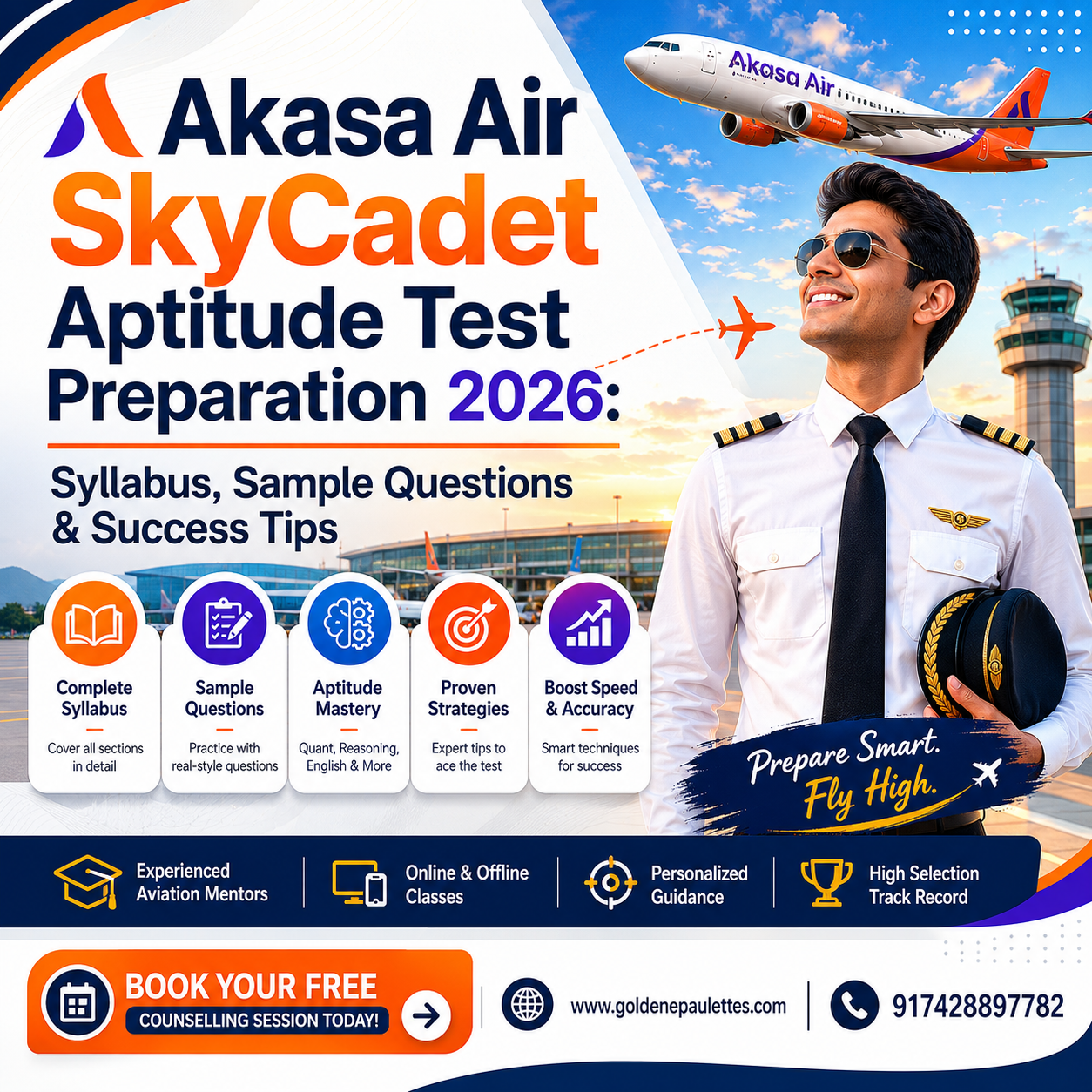
Aptitude Test Prep · 2026
Akasa Air SkyCadet Aptitude Test Preparation 2026
Syllabus, Eligibility, Sample Questions & Success Tips
The aptitude stage is where most cadet hopefuls are won or lost. Akasa Air describes its SkyCadet selection as a multi-stage process designed to identify individuals with the aptitude and passion required to succeed as future pilots — so a sharp, well-rehearsed performance matters as much as meeting eligibility. This guide covers the programme basics, complete eligibility, a full aptitude syllabus, sample questions, and how Golden Epaulettes Aviation structures your preparation.
Read this first. Akasa Air has not published an official aptitude-test syllabus, exam pattern, or sample papers. The syllabus and example questions below reflect standard airline pilot-aptitude assessments used across cadet programmes — they are illustrative preparation material, not actual Akasa SkyCadet questions. The official Akasa Air application is the only source of truth for the real format.
Akasa SkyCadet Programme — Every Basic Detail
Before the aptitude stage, know the programme you're applying to. All figures below are from the official Akasa Air SkyCadet page.
| Programme name | Akasa SkyCadet Pilot Training Programme |
| Airline | Akasa Air (all–Boeing 737 MAX fleet) |
| Structure | 3 phases: Ground School → CPL Flight Training → Boeing 737 MAX Type Rating |
| Ground School subjects | Air Regulations, Meteorology, Navigation, Aircraft Technical Knowledge, Human Performance (prepares for DGCA exams) |
| Flight training | Dual & solo flying, advanced navigation, instrument & cross-country ops → CPL Skill Test (DGCA + ICAO standards) |
| Type rating | Full-flight simulator, aircraft systems, SOPs & performance-based training on the Boeing 737 MAX |
| FTO partners | Dunes Aviation Academy (Bhavnagar); Skynex Aero Pvt. Ltd. (Jalgaon, Maharashtra) |
| Selection | Multi-stage selection process |
| Fee structure | Shared within the application form during the application process |
| Last date to apply | 24 June 2026 |
Eligibility Criteria (Verified)
You must satisfy every requirement published on the official Akasa Air SkyCadet page before applying:
| Criterion | Requirement |
|---|---|
| Nationality | Open only to Indian citizens |
| Minimum age | 18 years at the time of application |
| Maximum age | 40 years at the time of enrolment into the programme |
| Education | 10+2 with Physics, Mathematics, and English |
| Language | Written and spoken English proficiency |
| Background | No criminal record; no history of disciplinary or legal action |
Quick self-check before applying
- Are you an Indian citizen with a valid passport?
- Will you be within the 18–40 age windows (application / enrolment)?
- Did you complete 10+2 with Physics, Mathematics & English?
- Are you confident in spoken and written English?
- Is your background clear of any criminal/disciplinary record?
- Have you planned your DGCA medical?
Medical fitness (DGCA Class 1 / Class 2) is a standard requirement for any commercial pilot pathway in India. Confirm the exact medical requirements and timelines through the official Akasa Air application.
Where the Aptitude Test Fits in Selection
Akasa Air states only that selection is multi-stage. Across the industry, an aptitude/assessment stage almost always sits early in the funnel, before interviews. Understanding the shape helps you prepare in the right order.
Typical Cadet Selection Funnel (industry-standard)
Application & Screening
Eligibility check against the official criteria (citizenship, age, 10+2 PCM with English).
Aptitude Assessment
Computer-based reasoning, spatial and psychomotor tests plus personality/psychometric profiling.
Interview & Medical
Personal interview, group exercises, and DGCA medical fitness checks.
The exact number, order, and naming of stages for Akasa SkyCadet are not publicly detailed. Confirm the real sequence through the official application.
Complete Aptitude Test Syllabus
Pilot aptitude assessments measure the raw cognitive and coordination abilities flight training later sharpens. Below is a complete, area-by-area breakdown with the sub-topics worth drilling — the same domains Golden Epaulettes' airline-preparation track is built around.
| Area | Sub-topics to master |
|---|---|
| 1. Numerical reasoning |
|
| 2. Verbal reasoning & English |
|
| 3. Spatial & orientation |
|
| 4. Abstract / logical reasoning |
|
| 5. Physics & maths fundamentals |
|
| 6. Instrument comprehension |
|
| 7. Psychomotor & multitasking |
|
| 8. Memory & concentration |
|
| 9. Psychometric / personality |
|
These nine areas are standard across global pilot-aptitude systems. Akasa has not confirmed which specific tests it uses, so train breadth across all of them rather than betting on one format.
Sample Questions (Illustrative)
The items below are original practice examples written to show question types, not real Akasa questions. Use them to recognise formats and build speed.
An aircraft cruises at 480 km/h. How far does it travel in 45 minutes?
- 320 km
- 360 km
- 400 km
- 420 km
Answer: 360 km. 45 min = 0.75 h; 480 × 0.75 = 360.
Find the next number: 2, 6, 12, 20, 30, ?
- 36
- 40
- 42
- 44
Answer: 42. Differences grow 4, 6, 8, 10, 12 → 30 + 12 = 42.
You are flying on a heading of 090° (due East) and turn 90° to the left. What is your new heading?
- 360° / North
- 180° / South
- 270° / West
- 045° / North-East
Answer: North (360°). A left turn subtracts: 090° − 090° = 000°/360°.
"Crew must complete the pre-flight checklist before requesting pushback." Which statement is correct?
- Pushback can be requested during the checklist.
- The checklist is finished first, then pushback is requested.
- Pushback replaces the checklist.
- The checklist is optional.
Answer: The checklist is completed before requesting pushback. Read instructions literally and in order.
How Golden Epaulettes Aviation Prepares You
Golden Epaulettes Aviation is an ISO 9001:2015–certified pilot training institute based in Dwarka, New Delhi, led by founders Capt. Awdhesh Tomar and Capt. Deval Soni (both A320 Commanders). Its preparation maps directly onto the syllabus above.
| Aptitude area | Golden Epaulettes preparation |
|---|---|
| Reasoning & aptitude | CASS/COMPASS-style aptitude preparation |
| Personality & profiling | Psychometry preparation |
| Technical fundamentals | DGCA ground classes: Air Navigation, Meteorology, Air Regulations, Technical General |
| Exam temperament | DGCA 2026–aligned mock test series for speed & accuracy under timing |
| Interview & communication | Interview preparation & group discussion guides; English focus throughout |
| Cockpit feel | A320 simulator sessions |
| Right-fit decisions | Free one-on-one counselling with airline captains |
Success Tips for the Aptitude Stage
Rebuild mental maths first. Train fast, calculator-free arithmetic — ratios, percentages, and time–speed–distance — until it's automatic.
Practise under the clock. Aptitude tests reward speed with accuracy, so always rehearse with a timer.
Drill one area at a time, then mix. Master each domain separately, then sit full mixed mocks to build stamina.
Strengthen spatial orientation. Get comfortable with headings, turns, and reading basic instruments — where non-aviation candidates lose marks.
Answer psychometric tests honestly. Profiling looks for consistency and a genuine safety mindset; gaming it backfires.
Sharpen your English. It's an explicit Akasa requirement and underpins both verbal reasoning and the interview.
Rest before test day. Reaction time, memory, and multitasking all degrade when you're tired.
Final Word
The aptitude stage isn't about cramming facts — it's about training abilities. Candidates who start early, drill the right domains, and rehearse under realistic timing walk in calm and perform. Golden Epaulettes Aviation cannot place you in the SkyCadet programme, and no honest institute can, but it can build the reasoning, speed, and temperament that selection assessments reward.
Apply directly through Akasa Air, prepare with intent, and give yourself the strongest possible shot at the flight deck.