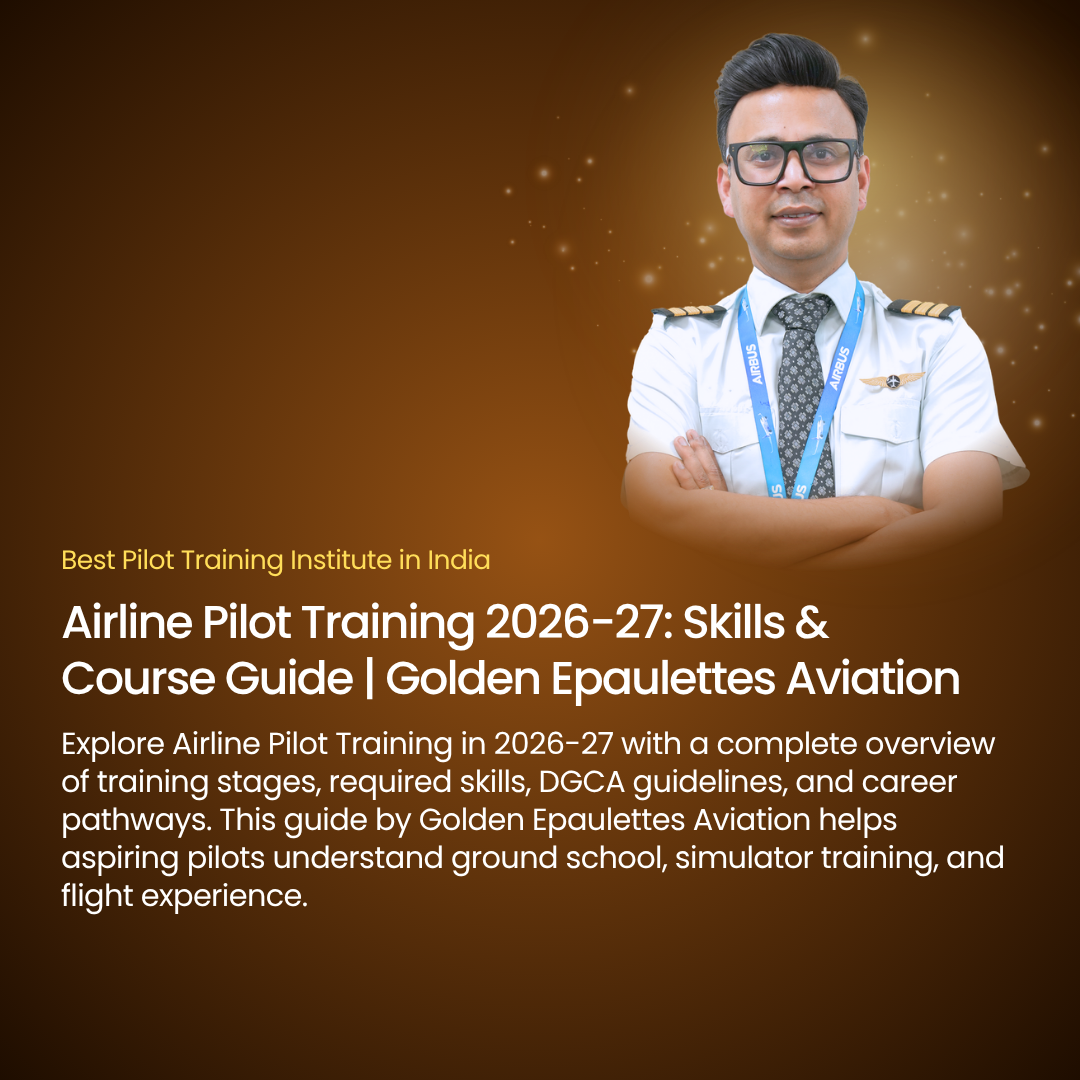
The path to an airline cockpit in India is one of the most clearly defined professional journeys in any career field — and in 2026, it is also one of the most financially and personally rewarding journeys a young professional can undertake. Airline pilot training 2026 in India is shaped by a combination of unprecedented fleet expansion from carriers like IndiGo, Air India, and Akasa Air, a regulatory framework set by the Directorate General of Civil Aviation (DGCA) that aligns with ICAO global standards, and a ground school and flying training ecosystem that — when navigated correctly — can take a motivated Class 12 student to a First Officer seat in an Airbus or Boeing within three to four years. This comprehensive guide by Golden Epaulettes Aviation — the leading Aviation Academy in Dwarka and one of the best pilot training academies in Delhi — covers every dimension of how to become airline pilot India: the training course structure, the skills airlines demand, the DGCA requirements, the selection process, and the career trajectory that follows.
Whether you are a student in Class 12 asking how to become airline pilot India for the first time, a CPL holder preparing for your first airline application, or a professional evaluating an airline pilot career India change, this guide delivers the complete, accurate picture of airline pilot requirements India in 2026 — from initial eligibility through type rating to your first airline payslip and beyond. The aviation career India landscape has never been more promising, and understanding how to navigate it from the very beginning gives every aspiring pilot the best possible start.
Why Airline Pilot Training in India Is Worth the Investment in 2026
The aviation career India story in 2026 is one of structural, sustained demand that makes the airline pilot training 2026 investment case stronger than at virtually any point in the history of Indian commercial aviation. India has become the world's third-largest domestic aviation market by passenger numbers. IndiGo — India's largest carrier — holds confirmed aircraft orders exceeding 500 jets. Air India, under Tata Group transformation, has placed one of the largest aircraft orders in the airline's history covering both narrow-body and wide-body types. Akasa Air, India's newest carrier, entered with a committed 72-aircraft Boeing order and continues to expand. Each new aircraft requires two licensed crew members for every flight — and a considerably larger pool of reserve and on-leave pilots behind them. The arithmetic of pilot training course India demand is straightforward: more aircraft, more routes, more passengers, more pilots needed. The ICAO Asia-Pacific projections confirm that India will require 9,000–12,000 new commercial pilots by 2032 — a figure that cannot be met by the current training pipeline without significant expansion in enrollment at institutions like Golden Epaulettes Aviation, the Aviation Academy in Dwarka.
Beyond the volume argument, the airline pilot career India delivers a quality of professional life that few other careers match. The salary trajectory — from ₹18–30 Lakhs in the first year as a First Officer to ₹84 Lakhs to ₹1.8 Crore as a Senior Captain — is among the highest for any professional career in India. The working pattern — structured rosters, scheduled time off, international layovers — is fundamentally different from the unstructured availability that many senior Indian professionals experience. And the daily professional satisfaction of operating a sophisticated machine across hundreds of miles of Indian airspace, carrying hundreds of passengers safely to their destinations, is genuinely distinctive. Understanding this full picture is part of the orientation that Golden Epaulettes Aviation, the best pilot training academy in Delhi for DGCA preparation, provides to every student beginning their airline pilot training 2026 journey.
Airline Pilot Requirements India: The Complete Qualification Framework
The airline pilot requirements India are defined by the DGCA, shaped by ICAO Annex 1, and supplemented by the specific selection criteria of individual airline operators. Meeting the DGCA minimum requirements gets a pilot legally qualified — but airline selection processes typically apply additional filters that separate the legally qualified from the operationally competitive. Understanding both layers — the regulatory floor and the airline performance standard — is essential for every candidate planning their pilot training course India to ensure that their preparation is calibrated correctly from the start at any Pilot Training Institute in Dwarka or flight school Delhi.
| Requirement Category | DGCA Minimum Standard | Airline Selection Standard (Typical) |
|---|---|---|
| Age | 18 years minimum for CPL | Usually 18–35 for cadet programs; no upper limit for direct entry |
| Education | Class 12 with Physics and Mathematics | Same — Class 12 Physics and Mathematics non-negotiable |
| Medical | DGCA Class 1 current | Class 1 current; airlines may impose additional fitness standards |
| License | DGCA Commercial Pilot License | DGCA CPL + type rating on airline's aircraft type |
| Flying Hours | 200 hours minimum for CPL | 200–250 hours typical; some carriers specify more for direct entry |
| English Proficiency | ICAO ELP Level 4 minimum | Level 4 minimum; Level 5/6 preferred; strong spoken English assessed |
| DGCA Theory | All 7 CPL subjects cleared | All 7 cleared; first-attempt success viewed favourably |
| RTR (Aero) | Mandatory for CPL commercial ops | Mandatory — RTR must be valid at time of application |
| Technical Knowledge | DGCA syllabus level | Above DGCA syllabus level — airline technical interviews test deeper knowledge |
| Soft Skills | Not formally assessed by DGCA | CRM, communication, teamwork, stress management assessed in psychometric tests |
The Gap That Matters: The difference between the DGCA minimum standard and the airline selection standard is where most candidates either succeed or struggle. Technical knowledge above DGCA syllabus depth, communication quality, and CRM awareness are the specific areas where structured ground school preparation at the DGCA CPL Ground Classes at Golden Epaulettes Aviation, the best pilot training academy in Delhi, makes a direct and measurable difference to selection outcomes.
The Airline Pilot Training Course India: Structure from Zero to First Officer
The pilot training course India for an airline career follows a clear five-stage structure — each stage building on the previous and each requiring specific preparation for the stage that follows. Understanding this complete structure from the outset helps every student enrolled in aviation training programs India make better decisions about sequencing, investment allocation, and preparation priorities at every stage. The guide below represents the pathway that students at the Pilot Training Academy in Dwarka Delhi follow through the Cadet Pilot Program at Golden Epaulettes Aviation:
Stage 1 — Academic and Medical Foundation
The starting point for any airline pilot training 2026 journey is verifying academic eligibility and medical fitness. Class 12 with Physics and Mathematics from a recognised board is the non-negotiable educational foundation. The DGCA Class 1 Medical Certificate — obtained from a DGCA-approved Civil Aviation Medical Examiner (CAME) — must be secured before significant financial commitment to flying training. This medical clearance should be the first active step after academic eligibility is confirmed, because discovering a disqualifying medical condition after enrolling at an FTO represents a preventable financial loss of significant magnitude. Understanding how to become a pilot India correctly means sequencing these foundational steps before advancing to training commitments.
Stage 2 — DGCA Theory Examinations
All seven DGCA CPL theory subjects — Air Navigation, Aviation Meteorology, Air Regulations, Technical General, Technical Specific, Advanced Meteorology, and RTR (Aero) — must be cleared through the DGCA eCAAT portal. All seven must be cleared within a seven-year validity window from the date of first attempt. The preparation for these papers at a quality aviation academy Delhi like Golden Epaulettes Aviation in Dwarka is not optional supplementation — it is the core academic investment that determines whether DGCA examinations are cleared efficiently on the first attempt or expensively through multiple reattempts. First-attempt success across all seven subjects is the target, and it is achievable with structured preparation at the best pilot training academy in Delhi.
Stage 3 — Flying Training at a DGCA-Approved FTO
Flying training at a DGCA-approved Flying Training Organisation (FTO) builds the 200 total hours required for CPL grant — covering basic handling, circuit flying, cross-country navigation, instrument flying, and night operations. The choice of FTO significantly affects both the quality of skills developed and the timeline to CPL skill test standard. Key evaluation criteria for FTO selection include current DGCA approval status, fleet availability and maintenance record, instructor quality, CPL skill test pass rates, and total cost transparency from enrollment to license. The Cadet Pilot Program at Golden Epaulettes Aviation provides structured FTO selection guidance as part of the pathway support for every student at the Pilot Training Institute in Dwarka.
Stage 4 — Type Rating
After CPL grant, a type rating on the specific aircraft type operated by the target airline is required before commercial line operations can begin. The Airbus A320 family type rating is the most in-demand entry qualification given IndiGo's dominant market share. A320 type ratings are conducted at approved Type Rating Training Organisations (TRTOs) and typically take 6–8 weeks, covering ground school on aircraft systems, fixed-base simulator sessions, full-motion simulator sessions, and a line check. Type rating costs range from ₹25–40 Lakhs and can be either self-funded or airline-sponsored through cadet bond programs. The technical knowledge depth built in DGCA pilot training India ground school preparation directly reduces the time needed to absorb type-specific systems knowledge in the type rating course.
Stage 5 — Airline Selection and Line Flying
With CPL and type rating in hand, the airline selection process begins. Each carrier runs its own multi-stage selection covering documentation verification, computer-based technical and aptitude testing, simulator assessment, technical interview, HR/psychometric evaluation, and medical validation. The entire process from application to joining typically takes 3–12 months depending on the airline's intake cycle and the candidate's position in the selection queue. Line flying as a First Officer begins with an Initial Operating Experience (IOE) — supervised line flights with a Training Captain — before solo First Officer operations commence. This is the moment when the airline pilot career India becomes a reality, and the training investment begins its long-term financial return.
The Complete Airline Pilot Career Pathway: Zero to Captain
The flowchart below maps the complete airline pilot training 2026 journey from Class 12 eligibility to Senior Captain — the full career arc that every student beginning their pilot training India 2026 program at the Aviation Academy in Dwarka is ultimately working toward:
Class 12 — Physics & Mathematics Confirmed
Academic foundation verified. Both subjects cleared from a recognised board. If missing, private candidate appearance planned. Career counselling at Golden Epaulettes Aviation ideally begins at this stage.
DGCA Class 1 Medical Clearance
First active step before any financial commitment to training. DGCA-approved CAME examination. Medical clearance confirmed before FTO enrollment or significant ground school investment is made.
DGCA CPL Ground Classes — All 7 Subjects
Enroll in DGCA CPL Ground Classes at Golden Epaulettes Aviation, the Pilot Training Academy in Dwarka Delhi. Air Navigation, Aviation Meteorology, Air Regulations, Technical General, Technical Specific, Advanced Met, RTR (Aero) — all 7 subjects cleared on the first attempt through structured airline-pilot faculty coaching.
Flying Training at DGCA-Approved FTO — 200 Hours
SPL application, FTO enrollment, and full flying training program. Basic handling through PPL, cross-country navigation, instrument flying (10 hrs), night flying (5 hrs), advanced manoeuvres, and CPL skill test. Logbook maintained meticulously throughout. Cadet Pilot Program FTO guidance applied here.
RTR (Aero) License — WPC Wing
Written and oral RTR examination cleared. Mandatory for all commercial operations. RTR (Aero) coaching at Golden Epaulettes Aviation, the aviation academy Delhi, prepares candidates for both components including the practical oral assessment.
DGCA Commercial Pilot License Issued
Full CPL documentation package submitted via eCAAT portal. License issued. The legal qualification for paid commercial flying in India is now held. The airline career journey can begin from this point forward.
Type Rating — A320 / B737 / ATR (6–8 weeks)
Aircraft-specific qualification at a DGCA-approved TRTO. Self-funded (₹25–40 Lakhs) or airline-sponsored through cadet bond program. Ground school, FBS sessions, FMS sessions, line check. The final qualification before airline employment begins.
Airline Selection — Multi-Stage Process
Application, CBT technical and aptitude testing, simulator assessment, technical interview, HR/psychometric evaluation, airline medical validation. Timeline: 3–12 months from application to joining offer depending on carrier and intake cycle.
First Officer — Line Flying Begins
Initial Operating Experience (IOE) with Training Captain. Solo First Officer operations. CTC ₹18–30 Lakhs year one. Seniority number assigned. The airline pilot career India is now operational — and the investment in pilot training course India begins its long-term financial return from the first payslip.
Captain Upgrade → Senior Captain
Seniority-based progression from First Officer (₹18–30L) to Senior First Officer (₹30–48L) to Captain (₹48–84L) to Senior/Wide-Body Captain (₹84L–1.8 Crore). The full career arc typically spans 12–18 years from joining to Senior Captain — the peak of airline pilot career India in 2026.
Airline Pilot Skills India: What Airlines Look for Beyond the License
The airline pilot skills India that distinguish successful airline selection candidates from those who do not make the cut extend well beyond technical knowledge and flying hours. Indian airline selection processes in 2026 have evolved to assess multiple competency dimensions simultaneously — reflecting the CRM (Crew Resource Management) philosophy that modern airline operations depend on and that the commercial pilot training India ecosystem must produce if it is to meet airline needs rather than just regulatory minimums. Every student at the Pilot Training Academy in Dwarka Delhi who aspires to an airline career needs to understand and develop these competencies alongside their DGCA theory preparation at the best pilot training academy in Delhi.
Technical Competencies
Aircraft systems depth beyond DGCA exam level — airlines test at the level of a newly type-rated pilot, not a CPL candidate. Instrument flying proficiency — especially ILS and NDB approach procedures. Performance calculation — takeoff and landing data, fuel planning, weight and balance. Navigation — chart reading, flight planning, position fixing. Meteorology — weather chart interpretation, TAF/METAR decoding, weather decision-making. All built through the DGCA CPL Ground Classes at Golden Epaulettes Aviation.
Non-Technical Competencies
Communication — clear, professional radio telephony and interpersonal communication. Crew Resource Management — assertiveness balanced against authority, cross-checking culture. Situational awareness — maintaining a current, accurate picture of the flight at all times. Decision making — structured, timely, appropriate action under pressure. Workload management — Aviate-Navigate-Communicate hierarchy. Stress resilience — consistent performance under examiner observation and time pressure. Built through the comprehensive Cadet Pilot Program at the Aviation Academy in Dwarka.
Indian Airline Selection Process: What Happens at Each Stage
The airline selection process is the most rigorous professional assessment most CPL holders will ever undergo — and understanding each stage in detail allows candidates from any quality flight school Delhi or Pilot Training Institute in Dwarka to prepare appropriately rather than arriving at the simulator assessment or technical interview underprepared for its specific demands. The five-stage selection structure below reflects the typical process at major Indian carriers in 2026, though specific details vary by airline and intake type.
Document Screening
CPL validity, Class 1 Medical currency, RTR (Aero) license, all 7 DGCA theory pass certificates, RTR, flying hours verification. Online application portal. Incomplete documentation = immediate elimination.
Computer-Based Testing
Technical knowledge (aircraft systems, navigation, met, regulations), English aptitude, numerical reasoning, spatial awareness, and sometimes pilot aptitude batteries. Strong ground school preparation directly improves CBT performance.
Simulator Assessment
Fixed-base or full-motion simulator on A320 or similar type. Assessed on basic aircraft handling, instrument approach, normal and abnormal procedures. Demonstrates actual piloting capability — not just theoretical knowledge.
Technical Interview
Panel interview with airline training captain or fleet manager. Tests aircraft systems, performance, aerodynamics, emergency procedures, and meteorology at type-rating depth. Most demanding technical assessment in the process.
HR and Psychometric
Personality profiling, CRM scenario assessment, communication evaluation, stress behaviour analysis. Airline assesses cultural fit and CRM competency. Group exercises in some cadet program selections.
DGCA Pilot Training India: The Regulatory Framework Behind Every Stage
The DGCA pilot training India regulatory framework provides the legal structure within which every element of the airline pilot training journey operates. The Aircraft Act 1934, the Aircraft Rules 1937, and the Civil Aviation Requirements (CARs) issued by the DGCA govern licensing, medical standards, flying training organisations, and the operational requirements of commercial aviation. For every student in pilot training India 2026, understanding this regulatory context is not just examination knowledge — it is the professional literacy that airline technical interviewers expect from candidates who claim to be prepared for a commercial aviation career.
CAR Section 7 Series B defines CPL licensing requirements; CAR Section 7 Series C governs medical standards; CAR Section 8 Series Y regulates flying training organisations; and the DGCA's implementation of ICAO Annex 1 ensures that Indian CPL holders meet internationally recognised standards. The progressive tightening of DGCA examination standards and the increasing alignment of Indian airline selection processes with international standards reflect the DGCA's commitment to ensuring that commercial pilot training India produces professionals who meet the safety requirements of one of the world's fastest-growing aviation markets. For students at the Pilot Training Institute in Dwarka and any other aviation academy Delhi, this regulatory literacy is built through the Air Regulations module of the DGCA CPL Ground Classes at Golden Epaulettes Aviation.
Airline Pilot Career India: Salary Trajectory and Long-Term Returns
The airline pilot career India salary trajectory is one of the strongest arguments for the pilot training course India investment in 2026. The total investment — typically ₹70–115 Lakhs including CPL training, type rating, and ground school — is recovered within 5–7 years at First Officer salary levels, and within 12 months once Captain upgrade is achieved. The salary table below reflects current market rates at Indian scheduled carriers:
FO
First Officer — Narrow Body
Annual CTC ₹18–30 Lakhs. IOE completion, solo line flying commences. Seniority number accumulates from day one. Training investment begins its return.
Senior FO
Senior First Officer
Annual CTC ₹30–48 Lakhs. Command readiness profile develops. Check results, seniority, and fleet hours build toward upgrade consideration. Training investment fully recovered within this period at most salary levels.
Captain
Captain — Narrow Body
Annual CTC ₹48–84 Lakhs. Command course completed, full PIC authority. Eligibility for Check Captain, Training Captain, or wide-body transition. Peak domestic earning period begins.
Sr. Captain
Senior / Wide-Body Captain
Annual CTC ₹84 Lakhs–1.8 Crore. Wide-body type rating (B777, B787, A350) for international long-haul operations. Peak earning period of the entire airline pilot career India. Investment return exceeds initial cost many times over annually.
Aviation Training Programs India: Choosing the Right Preparation Path
The aviation training programs India available to CPL candidates in 2026 vary significantly in quality, structure, and outcome — from excellent, rigorous programs that produce first-attempt DGCA success and strong airline selection performance, to poorly structured programs that leave candidates underprepared for both the examination and the airline technical interview that follows. Understanding how to evaluate any pilot course India or ground school program before enrolling is as important as understanding the CPL pathway itself, because the preparation quality at any aviation academy Delhi or best pilot training academy in Delhi directly determines whether the subsequent investment in flying training and type rating produces an employed airline pilot or a licensed pilot who cannot pass airline selection.
The key evaluation criteria for any aviation training programs India program are faculty credentials (active or retired airline pilots, not general educators), syllabus currency (2026 DGCA alignment, not outdated editions), batch size (small enough for individual attention, especially in demanding subjects like Air Navigation), mock test quality (DGCA-pattern, faculty-debriefed, not generic question banks), and post-exam support (FTO guidance, documentation help, airline interview preparation). Programs that check all five criteria consistently produce the first-attempt DGCA success rates and airline selection outcomes that justify the investment in structured ground school over self-study. At Golden Epaulettes Aviation, the Pilot Training Academy in Dwarka Delhi, all five criteria are core to every batch.
CPL Training India vs Type Rating vs Line Flying: Understanding the Three Investments
The CPL training India investment is often discussed as a single number — "₹45–75 Lakhs for a CPL" — but the airline pilot journey actually involves three distinct investment stages, each building on the previous and each requiring specific preparation to maximise value. Understanding these three stages separately helps candidates at the Pilot Training Academy in Dwarka Delhi and any flight school Delhi plan their financial journey with accurate expectations:
| Investment Stage | Components | Typical Cost | Duration | Outcome |
|---|---|---|---|---|
| CPL Training | Ground school, flying training (200 hrs), medical, DGCA exams, RTR, documentation | ₹45–65 Lakhs | 2–3.5 years | DGCA Commercial Pilot License |
| Type Rating | A320/B737 type rating at TRTO — ground school + simulators + line check | ₹25–40 Lakhs (self-funded) | 6–8 weeks | Type Rating on airline aircraft |
| Line Flying / IOE | Initial Operating Experience with Training Captain — supervised line flights | Paid by airline (salary during IOE) | 30–70 sectors | Released to line as solo First Officer |
| Total Self-Funded | CPL + Type Rating combined | ₹70–105 Lakhs | 2.5–4 years | Employed airline First Officer |
| Cadet Bond Program | CPL self-funded; airline sponsors type rating in exchange for service bond | ₹45–65 Lakhs (CPL only) | 2.5–3.5 years to joining | Employed FO with airline bond commitment |
Golden Epaulettes Aviation: Where Airline Pilot Preparation Begins
Golden Epaulettes Aviation, the Aviation Academy in Dwarka and the best pilot training academy in Delhi for DGCA CPL ground school, is specifically designed around the airline pilot career outcome — not just the DGCA examination certificate. Every program at the Pilot Training Institute in Dwarka builds knowledge at the depth that airline technical interviews demand, communication skills that airline HR assessors look for, and the professional self-awareness that CRM psychometric assessments profile. The faculty of airline pilots and aviation professionals ensures that ground school preparation is always contextualised in operational reality — making the connection between theory and career explicit in every session.
DGCA Theory Programs
Complete DGCA CPL Ground Classes across all 7 subjects. Specialist Air Navigation with CRP-5 proficiency development. Aviation Meteorology with chart interpretation. RTR (Aero) written and oral preparation. All updated for 2026 DGCA syllabus at the Pilot Training Academy in Dwarka Delhi.
Airline Career Preparation
The comprehensive Cadet Pilot Program extends beyond DGCA exams to FTO selection guidance, DGCA documentation support, type rating pathway advice, and dedicated airline technical interview preparation — addressing both the technical and non-technical competencies that Indian airline selection processes assess. Complete airline pilot career guidance from Class 12 through first airline offer.
Community Discussions: Airline Pilot Training on Quora and Reddit
Aspiring airline pilots across India actively discuss airline pilot training 2026 realities, pilot training course India recommendations, and airline selection experiences on community platforms. These discussions provide peer perspective alongside the structured guidance available from Golden Epaulettes Aviation, the Aviation Academy in Dwarka.
Quora — How to Become Airline Pilot India & CPL Training
Active threads on airline pilot requirements India, how to become airline pilot India timelines, commercial pilot training India FTO experiences, pilot training course India quality comparisons, airline pilot career India salary realities, and DGCA pilot training India exam experiences from candidates at every stage of pilot training India 2026.
Explore airline pilot training discussions on Quora →Reddit — r/flying and r/aviationIndia
Community threads on airline pilot skills India selection tips, CPL training India FTO comparisons, aviation career India salary trajectory discussions, aviation training programs India quality reviews, and honest accounts of airline pilot career India progression from working First Officers at Indian carriers.
r/flying on Reddit → r/aviationIndia on Reddit →Verify Regulatory Information: Airline selection requirements, DGCA licensing standards, and CPL training course India details change periodically. Always verify current requirements through the DGCA official website and ICAO publications before making training and financial commitments. The advisory team at Golden Epaulettes Aviation in Dwarka provides current, verified guidance as part of every enrollment consultation.
Frequently Asked Questions — Airline Pilot Training India 2026
Conclusion: The Airline Cockpit Is Achievable — With the Right Preparation
The airline pilot training 2026 journey in India is demanding — academically, financially, physically, and professionally. But it is also one of the most clearly defined and achievable professional pathways available to any motivated Class 12 student in India. The regulatory framework is clear, the qualification requirements are specific, the airline demand is strong, and the financial returns are exceptional. What separates the candidates who reach the airline cockpit from those who get stuck along the way is almost always preparation quality — at the DGCA examination stage, at the flying training stage, and at the airline selection stage.
At Golden Epaulettes Aviation — the Aviation Academy in Dwarka and the best pilot training academy in Delhi for DGCA pilot training India ground school preparation — every program is built around the airline career outcome. The DGCA CPL Ground Classes, specialist Air Navigation and Aviation Meteorology coaching, RTR (Aero) preparation, and the comprehensive Cadet Pilot Program collectively give every student the preparation depth, exam confidence, and airline readiness that turns a pilot training course India enrollment into an employed airline First Officer career. That outcome is what every student who walks through the door at the Pilot Training Institute in Dwarka is working toward — and it is what Golden Epaulettes Aviation is built to deliver.
Visit: www.goldenepaulettes.com | Location: Dwarka, New Delhi | DGCA Approved Ground School
Explore the Cadet Pilot Program →